

Direct-hire LATAM talent for real estate
Hire a Virtual Transaction Coordinator
Missed deadlines, scattered documents, and slow follow-ups do not just create stress, they can put a deal at risk. A LATAM-based virtual transaction coordinator manages every file from executed contract to closing, in your systems and during U.S. hours, so your agents keep selling.
Free
Consultations
Direct Hire
72-Hour Match, No Middleman
6-Month
Replacement Guarantee
★★★★★
Rated on Google
The basics
What Is a Virtual Transaction Coordinator?
Transaction coordination is one of the most time-sensitive jobs in a real estate operation. Every file carries contracts, disclosures, contingency deadlines, compliance requirements, and constant communication with buyers, sellers, lenders, escrow, attorneys, and your own team. As deal volume grows, that work pulls agents away from clients, and hiring locally means higher payroll, long onboarding, and a hard search for someone consistent and detail-oriented.
A virtual transaction coordinator is a remote professional who manages that contract-to-close workload for you. Hiring one from Latin America gives you an English-fluent specialist who understands U.S. real estate workflows, works U.S. business hours, and operates inside your transaction platform and CRM at $16,800–$24,000 per year. That is direct hire: your coordinator works exclusively for your team, learns your checklists and your lender and title contacts, and stays with you. No agency markup. No per-file fees.
The math is not complicated. A licensed in-house transaction coordinator in the U.S. typically costs $50,000–$70,000 per year plus benefits. A full-time LATAM coordinator costs $16,800–$24,000 a year plus a one-time $2,000 placement fee, and 100% of the salary goes to your coordinator. Use the calculator below to see the hours and dollars you get back compared with doing it yourselves, or see our real estate virtual assistant cost guide.
Roles we commonly fill
Roles we place for transaction teams
📑
Transaction Coordinators
Run each file from executed contract to closing with every deadline tracked.
🏡
Listing Coordinators
Take a listing from signed to live, marketed, and under contract.
🗂️
Compliance and File Reviewers
Check documents against your brokerage checklist before a file goes to audit.
🔑
Closing Coordinators
Prepare final walkthroughs, closing paperwork, and post-closing files.
📞
ISAs and Lead Follow-Up Specialists
Respond to new leads within minutes and set appointments.
📋
Real Estate Administrative Assistants
Keep inboxes, calendars, and the back office organized.
What your VA handles
What a Virtual Transaction Coordinator Can Handle
Pick your side of the deal. The model is the same for both: direct hire, one $2,000 fee, 100% of salary to your coordinator. Looking for broader back-office support? See our real estate virtual assistant page.
📝
Offer-to-Contract Paperwork
The days after an accepted offer are the busiest. Your coordinator opens the file and gets every document where it belongs.
✓
File opened in your transaction platform from the executed contract
✓
Intro emails sent to client, lender, title, and listing side
✓
Contract, addenda, and disclosures collected and organized
✓
Signature requests sent and tracked
✓
Timeline created and shared with the team
🔍
Inspections, Appraisal, and Due Diligence
Third-party appointments slip when no one owns them. Your coordinator schedules and chases each one.
✓
Inspection and specialist visits scheduled with the client
✓
Inspection report and repair request tracking
✓
Appraisal ordering and access coordination
✓
HOA documents and condo certificates requested
✓
Results and next steps summarized for the agent
🏦
Lender and Title Coordination
A late loan or title item can move the closing date. Your coordinator keeps both sides in step.
✓
Regular lender status checks and condition tracking
✓
Title and escrow follow-up on commitments and fees
✓
Closing date and time confirmed with all parties
✓
Earnest money receipt and deposit confirmation
✓
Updates logged in the file
⏱️
Contingency and Deadline Tracking
Missed dates create risk and cost. Every deadline gets a reminder before it arrives.
✓
Contingency dates entered from the contract
✓
Reminders to the agent and client ahead of each date
✓
Extensions and addenda drafted for agent review
✓
Deadline calendar shared with the team
✓
Weekly status summary of every open file
💬
Buyer Updates and Client Communication
Buyers want to know where things stand. Your coordinator keeps them informed so the agent does not have to.
✓
Milestone updates sent to the buyer
✓
Questions answered or routed to the agent
✓
Move-in, utility, and key logistics reminders
✓
Document requests handled politely and tracked
✓
Communication logged in your CRM
🔑
Closing and Post-Close
The file is not finished at the closing table. Your coordinator wraps it up cleanly.
✓
Final walkthrough scheduled
✓
Closing disclosure and funds-to-close reminders
✓
Closing package and commission paperwork prepared
✓
Post-closing file organized and archived
✓
Review request and referral follow-up sent
Transaction tools your coordinator works inside:
Dotloop
SkySlope
Brokermint
TransactionDesk
Follow Up Boss
kvCORE
Salesforce
HubSpot
Google Drive
Dropbox
ClickUp
Asana
Roles we place
What Roles Can We Help You Fill?
Beyond your virtual transaction coordinator, we place remote talent for real estate teams, including:
How the options compare
Four Ways to Coordinate Your Transactions
With direct hire you own the relationship and pay no per-file or monthly fees.
🏢
In-house licensed coordinator
•
$50,000–$70,000 a year plus benefits
•
You run hiring, training, and turnover
•
Replacement means a new search
•
Limited to your local pool
📑
Per-file TC service
•
A fee on every closing
•
Cost rises with every deal
•
Often limited to the transaction itself
•
Shared across many agents
🔁
Managed VA service
✕
A monthly fee, every month
✕
The agency owns the relationship
✕
Often non-solicitation clauses
✕
Markup between you and the coordinator
⭐
Virtual Wizards
✓
$2,000 one-time placement fee
✓
You own the relationship
✓
100% of salary goes to your coordinator
✓
6-month free replacement guarantee
✓
No per-file or monthly fees, ever
Typical models, not quotes. Your numbers depend on the provider and the role.
Why LATAM
Why Agents and Teams Hire a Virtual Transaction Coordinator from Latin America
🏆
Top talent
We accept only the top 1% of applicants so you work with the very best professionals in Latin America. Over 95% of our assistants hold college degrees and bring proven experience in their fields.
💰
Cost-effective
Hiring through Virtual Wizards is significantly more cost-effective than hiring in the U.S. or Canada. By nearshoring, you can save up to 70% on payroll costs while keeping the quality of work high.
🗣️
English tested and bilingual
Every applicant must pass an English proficiency assessment. Our VAs are fully bilingual in English and Spanish (and in some cases English and Portuguese), so calls and emails with clients, lenders, and escrow stay clear.
🕘
U.S. business hours
Your coordinator works U.S.-aligned hours, so lender, title, and client questions are answered the same day, not the next morning.
🧾
Tax advantages
Since our VAs are not W-2 employees, you don’t need to pay payroll taxes, healthcare benefits, or retirement contributions. You get the talent you need without the overhead of traditional employment.
⏱️
Get your time back
Proper delegation lets you focus on clients, negotiations, and new business while your coordinator keeps every file on schedule.
Why Virtual Wizards
Why Work With Virtual Wizards?
Virtual Wizards helps you hire a dedicated, full-time virtual transaction coordinator: a LATAM professional who works directly inside your transaction platform and processes, building institutional knowledge of your checklists and partners over time. Our goal is long-term team capacity, not temporary outsourced support.
✓
Pre-vetted for real estate transactions: contracts, disclosures, deadlines, and closings
✓
Familiarity with Dotloop, SkySlope, Brokermint, TransactionDesk, and major CRMs
✓
C1+ English fluency: every candidate is communication-tested before introduction
✓
We place for long-term fit, not churn-and-burn turnover
✓
Every placement comes with a 6-month free replacement guarantee
💸
No per-file or monthly fees
Virtual Wizards charges a one-time placement fee. After that, you pay your coordinator directly. No per-closing charges, subscriptions, or hidden costs. Use our LATAM hiring cost calculator to compare roles.
🔑
You own the relationship
From day one, the working relationship is entirely yours. Your coordinator works exclusively with your team, with no third party managing them.
🌎
Pay your coordinator directly
You pay with tools such as Wise, Remitly, Gusto, or Rippling. We collect the banking details after the agreement is signed to keep payments simple.
Own the relationship
Why Owning the Relationship With Your Coordinator Matters
When you hire a virtual transaction coordinator, who holds the relationship decides who gets paid, who stays, and who knows your deals.
Most agents and teams compare transaction coordination on one number: the fee per file or the monthly price. The better question is who owns the relationship once someone is running your files. That choice decides who pays whom, who controls the coordinator’s pay and schedule, who has access to your client and deal data, and how much of your spend reaches the person doing the work.
How managed VA services actually work
In a managed service, the agency contracts the VA and places them with you. Each month, the agency bills you one all-inclusive fee, pays the VA a smaller amount, and keeps the difference. You rarely see what your VA earns. You usually don’t control their raises, their schedule, or who covers when they’re out. On paper the VA works for the agency, and you rent their time.
Those all-inclusive fees commonly run $2,500 to $4,000 a month depending on experience. The person behind the invoice typically earns a fraction of that, because transaction support salaries in Latin America run roughly $1,400 to $2,000 a month. The gap is the agency’s margin.
What the markup actually pays for
Here is the part most agencies don’t want to explain. After the match is made, many managed services do very little month to month beyond collecting your payment, sending the VA their share, and handling basic payroll paperwork. Moving money to a VA in Latin America costs a few dollars through tools like Wise, Remitly, Gusto, or Rippling. It does not cost $1,300 to $2,000 a month, which is often the size of the gap between what you are billed and what the VA is paid.
The markup isn’t buying you a better VA, better training, or better results. It is a toll on every month you keep the person. And because the fee never ends, the longer your VA stays, the more you overpay. A good VA is the asset you want to keep, and a managed service charges you more the longer you keep them.
Some managed services do provide real management: coaching, performance reviews, backup coverage. If you want that, ask what it costs and what you actually get. But if the honest answer is mostly payment processing, you are paying a premium for a transfer.
What you lose when you don’t own the relationship
Control over pay. If you can’t give your VA a raise or a bonus directly, your best people have little reason to stay. And because the agency keeps a large share of what you pay, the VA keeps less of it. That is a recipe for turnover.
Lock-in. Many agreements include non-solicitation clauses or buyout fees. If you leave the agency, you can lose the VA you spent months training, or pay extra to keep them.
Institutional knowledge. A transaction team runs on small details: your file checklist, which lenders and title reps respond fast, how you word a contingency reminder, which clients need a call before the weekend. Your coordinator learns all of it. If the agency can reassign or replace them, that knowledge walks out the door.
A middleman in every conversation. When pay, time off, and performance all run through a third party, simple things take longer, and your VA answers to two bosses.
What owning the relationship gives you
When you hire direct, the working relationship is entirely yours from day one. Your VA works exclusively with your company, takes direction from you, and builds knowledge of your portfolio, your vendors, and your workflows over time. You set the pay. You decide on raises. You talk to your VA directly, with no one in between.
That changes retention. When associates are paid fairly and feel connected to the company they work for, they tend to stay longer and perform better. A VA who stays two years is worth far more than one who rotates out after six months, because the value of a front-office hire compounds as they learn your business.
It also changes your flexibility. You can move a VA from part-time to full-time, add a second hire for leasing or accounting support, or shift responsibilities as your portfolio grows, without renegotiating a contract with an agency.
How we keep direct hire low-risk
Owning the relationship doesn’t mean going it alone. We handle the sourcing, vetting, and scheduling, deliver a shortlist of two to three candidates within 72 hours, and let you interview and choose. You pay a one-time $2,000 placement fee, and every placement comes with a 6-month free replacement guarantee. After the hire, you pay your VA directly through Wise, Remitly, Gusto, or Rippling, and we keep offering guidance so the placement works.
The 24-month math (example)
Managed service
$3,000 × 24 = $72,000
Direct hire
$1,800 × 24 + $2,000 = $45,200
Difference
$26,800
Example for a mid-level transaction coordinator earning $1,800 a month in both cases. Run your own numbers in the calculator above.
Before you sign with any provider
Six questions to ask
?
Who pays the VA, and how much of what I pay do they keep?
?
Is there a non-solicitation clause or a buyout fee?
?
What exactly does the monthly fee cover after the match?
?
Can I give my VA a raise or a bonus directly?
?
If I leave, can I keep my VA?
?
Who owns the working knowledge my VA builds?
Our placement process
How to Hire a Virtual Transaction Coordinator in 72 Hours
1
Free
Discovery Call
A quick consultation to understand your deal volume, your transaction platform, the roles you need filled, and your budget.
2
72-Hour Shortlist
Within 72 hours, you receive 2–3 pre-vetted LATAM candidates screened for real estate transaction experience, C1+ English fluency, and platform familiarity.
3
You Hire Directly
You interview and choose. We never make the hire for you. You pay your coordinator directly, with no middleman and no per-file fees.
Meet the talent
Virtual Transaction Coordinator Candidates
Watch intro videos from candidates in our LATAM pipeline before you ever book a call.
Andrea W.
Candidate
Humberto J.
Candidate
Keilyn L.
Candidate
Martha M.
Candidate
Ready when you are
Interview coordinators like these within 72 hours
Tell us your platform and deal volume. We send 2–3 pre-vetted candidates and you choose.
Get Started1,500+
Virtual transaction coordinators in our pipeline
100%
Fully screened and vetted
72 hours
To receive a candidate shortlist
85%
Of placements stay with clients for 1+ year
FAQ
Virtual Transaction Coordinator FAQ
What does a virtual transaction coordinator do?
+
A virtual transaction coordinator manages each real estate file from executed contract to closing: opening the file, collecting contracts, addenda, and disclosures, tracking contingency deadlines, coordinating with lenders, title, escrow, and clients, updating your transaction platform and CRM, and organizing the closed file.
How much does a virtual transaction coordinator cost?
+
A full-time LATAM virtual transaction coordinator typically earns $16,800–$24,000 a year ($1,400–$2,000 a month) depending on experience, paid directly to them. You pay Virtual Wizards a one-time $2,000 placement fee per hire and nothing per closing or monthly. For a deeper comparison, see our real estate virtual assistant ROI calculator.
Is a virtual transaction coordinator cheaper than a per-file service?
+
It depends on volume. Per-file fees grow with every closing, while a coordinator costs the same each month. A quick check: multiply your monthly closings by your per-file fee and by 12, then compare it with about $23,600 for a mid-level coordinator in year 1 and $21,600 a year after. Use the calculator on this page to see the time you get back as well.
Which transaction platforms do your coordinators know?
+
Our candidates are familiar with Dotloop, SkySlope, Brokermint, TransactionDesk, and similar platforms, along with CRMs such as Follow Up Boss, kvCORE, Salesforce, and HubSpot. If you use something more specific, we look for candidates with that experience.
Does a transaction coordinator need a real estate license?
+
Rules vary by state. A coordinator handles administrative and coordination work. Anything that requires a license, such as negotiating or advising clients, stays with your licensed agent or broker. Confirm the rules for your state and brokerage.
Can one coordinator handle both buyer-side and listing-side files?
+
Yes. One experienced coordinator can run buyer-side and listing-side transactions for a solo agent or a small team. Larger teams often add a second coordinator or a listing coordinator as volume grows. You can see how a team did it in our transaction coordinator placement case study.
What is the $2,000 placement fee, and how do I pay the coordinator?
+
The fee is a one-time charge per hire covering sourcing, vetting, your 2–3 candidate shortlist within 72 hours, interview scheduling, and your 6-month replacement guarantee. After that you pay your coordinator directly, using tools such as Wise, Remitly, Gusto, or Rippling. 100% of their salary goes to them. We take no cut and add no markup.
What if the coordinator doesn’t work out?
+
You are covered by a 6-month free replacement guarantee. If the hire isn’t the right fit inside six months, we find you a replacement with no new placement fee.
Can my coordinator also help with listings and marketing?
+
Yes, as capacity allows. Many teams start with transaction coordination and add listing input, MLS updates, or CRM upkeep. If marketing or lead follow-up becomes a full workload, a separate real estate virtual assistant usually makes sense.
How quickly can I hire, and do I choose the candidate?
+
Within 72 hours of your discovery call, we deliver a shortlist of 2–3 pre-vetted LATAM candidates. You interview and choose the person who fits your team and workflow. We never make the hire for you.

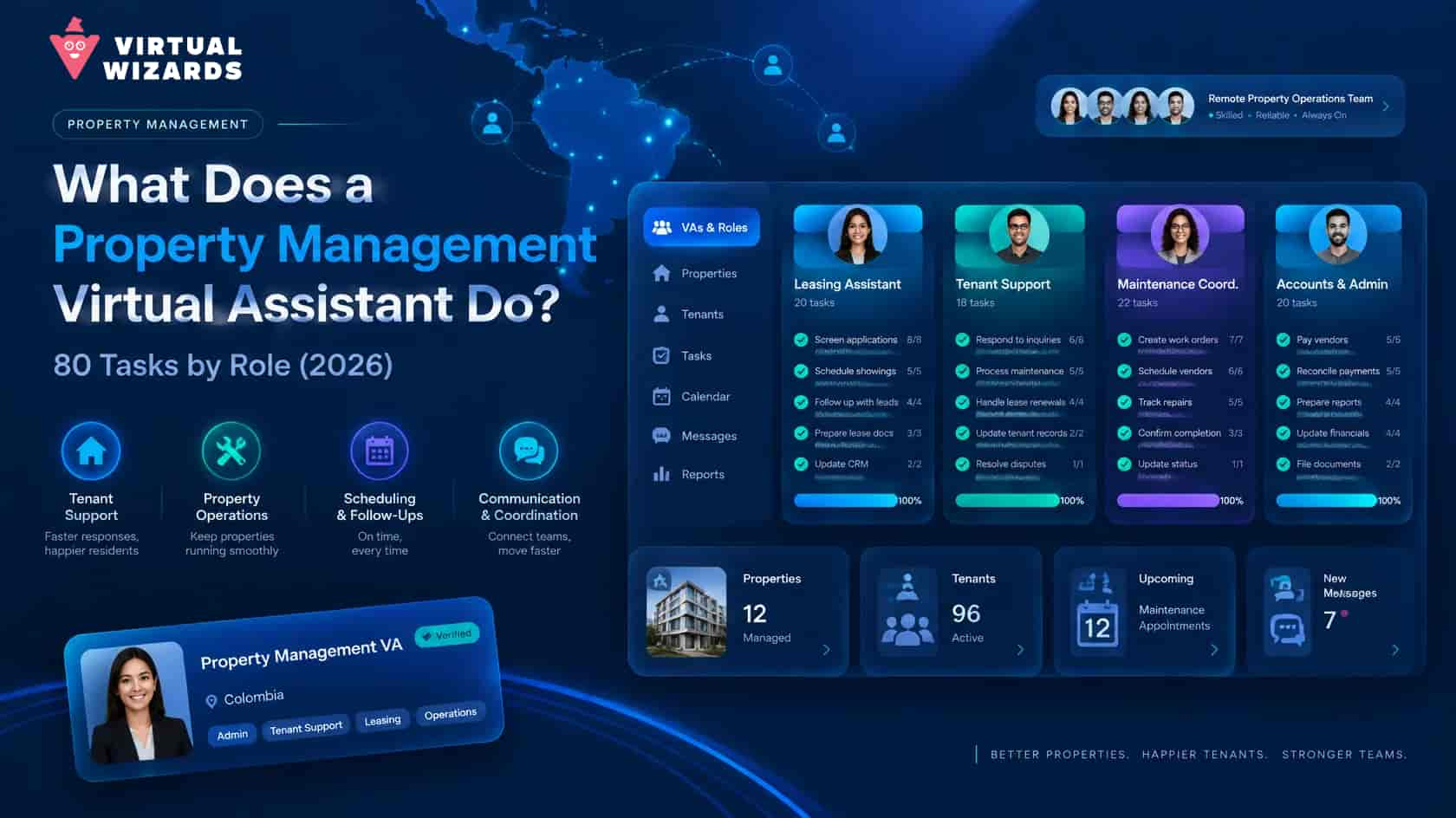
What Does a Property Management Virtual Assistant Do? 80 Tasks by Role (2026)
A complete list of property management virtual assistant tasks: maintenance, vendor sourcing, AP/AR, tenant support, collections, leasing, screening, BDR, and more, with what a VA owns, what you approve, and what stays with licensed staff.
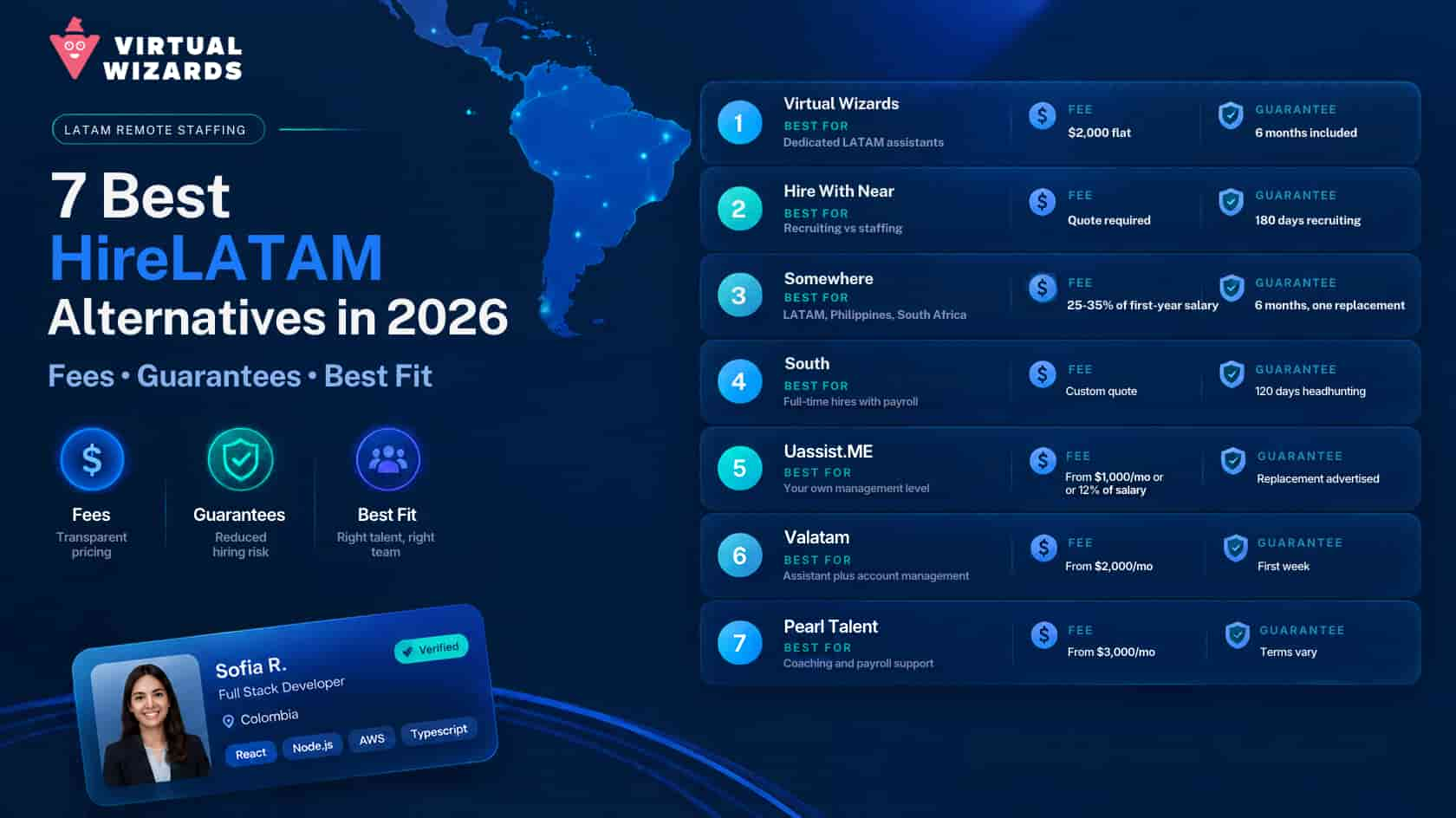
7 Best HireLATAM Alternatives in 2026 (Fees, Guarantees & Fit Compared)
Comparing HireLATAM alternatives? See 7 LATAM hiring options side by side, placement fees, replacement guarantees, hiring models, and who each fits, plus a free cost calculator.

Best Property Management Software Every VA Should Know (2026 Guide)
AppFolio, Buildium, Rent Manager, Propertyware, Rentvine, Property Meld, LeadSimple a complete guide to what each platform does, what a VA can own inside it, and how to evaluate platform fluency when hiring.