
Best Executive Assistant Companies in 2026: A Practical Guide to Cost, Control, and Performance

Table of Contents
TLDR
| Company | Model | Monthly Cost | EA Receives | Time Zone | Best For |
|---|---|---|---|---|---|
| Virtual Wizards Top Pick | Direct Hire | $1,600–$2,800/mo (salary only) + One-time $1,500–$3,000 placement fee |
100% of salary | LATAM (Real-Time U.S.) | Operators who want full ownership, the lowest long-term cost, and a dedicated team member. |
| Boldly | Subscription | $2,600–$6,500/mo | ~35–45% | U.S.-Based | Companies wanting senior U.S.-based executive assistants with managed support. |
| Prialto | Managed Subscription | $1,500–$3,600/mo | ~35–45% | Global (Guatemala & Philippines) | Executives wanting structured delegation with built-in management and backup coverage. |
| Viva Talent | Managed Subscription | $3,999–$4,999/mo | ~40–50% | LATAM | Fast-growing startups that want full-time nearshore support without managing the hire. |
| Athena | Managed Subscription | ~$3,000/mo + buyout up to $20K | ~40–50% | Global | Senior executives seeking delegation coaching and a long-term managed solution. |
The core question every Executive should ask: How much of what I pay actually reaches the person doing the work?
With every managed service on this list, between 35% and 65% of your monthly fee goes to the agency’s infrastructure — not your EA. With Virtual Wizards, 100% of your monthly payment goes directly to your assistant. See what a Virtual Wizards EA can handle →
Intro
A great executive assistant isn’t just someone who manages your inbox. That framing understates the role and leads to underwhelming hires.
The best EAs are operational partners. They protect your calendar, manage your stakeholder relationships, prepare you for every high-stakes conversation, coordinate the logistics of complex travel, and create the administrative infrastructure that lets you function at the level your role actually demands. When that role is filled well, the effect is structural — you stop operating in reaction mode and start operating with leverage.
When it’s filled poorly, the cost is invisible. It shows up in missed follow-ups, delayed decisions, and the persistent feeling that you’re doing work that shouldn’t require you.
The bigger question in 2026 isn’t whether an EA is worth it. That math is obvious. The question is how you hire one and what model gives you the best long-term outcome for the investment.
This guide breaks down the five executive assistant companies worth evaluating, compares the real costs behind each model, and makes a clear recommendation for operators focused on ownership, performance, and long-term ROI.
If you want to go deeper on the economics first: Real Cost of Outsourcing Virtual Assistants (And Why Direct Hire Wins)
1. Boldly

Positioning in the market
Boldly positions itself as a premium subscription staffing provider focused on experienced, U.S.-based talent. Unlike lower-cost VA services or marketplaces, their model is built around long-term support, reliability, and a fully managed client experience.
Type of assistant you get
Boldly provides senior-level assistants, often with 10–15 years of professional experience. These are not entry-level VAs. They are positioned as embedded team members who can support across executive administration, project coordination, marketing, customer service, and bookkeeping.
Strengths and limitations
Strengths:
- Highly experienced talent compared to most VA providers
- Strong onboarding and client success support
- Backup coverage ensures continuity
- Assistants integrate into your team and systems
Limitations:
- Higher price point than offshore or direct-hire options
- Subscription model can limit flexibility as you scale
- Not cost-efficient for high-volume, process-driven roles
Pricing structure
| Plan Hours | Monthly Cost | Effective Hourly Rate |
|---|---|---|
| 40 hours | $2,600/mo | $65/hr |
| 60 hours | $3,900/mo | $65/hr |
| 80 hours | $5,200/mo | $65/hr |
| 100 hours | $6,500/mo | $65/hr |
Additional notes:
- Specialized work (e.g. project management, design, development) may be billed at higher hourly rates
- Credit card payments may include an additional ~2.9% processing fee
- Custom plans (above 100 hours) are available upon request
Best use case
- Boldly is a strong fit for operators who want a high-touch, experienced assistant embedded into their team and are willing to pay a premium for reliability and support.
- It works best for executive support, project coordination, and client-facing roles where consistency and experience matter more than cost efficiency.
Use our Virtual Assistant Salary Calculator
to compare real 2026 salary data between the U.S. and LATAM.
2. Virtual Wizards

Positioning in the market
Virtual Wizards operates as a direct-hire recruitment partner, not a subscription VA service and not a managed platform. The model is built around one thing: finding you a trained, vetted executive assistant from Latin America and placing them directly inside your team, permanently, with no ongoing agency fees.
You own the relationship from day one. The assistant works exclusively for you, on your hours, inside your systems. There is no intermediary managing performance, no platform monitoring activity, and no monthly markup flowing to a third party. Once the placement is made, the business is between you and your EA.
This is a fundamentally different structure than every other provider on this list.
For a full breakdown of what a Virtual Wizards executive assistant handles, inbox and calendar management, board and investor communications, travel coordination, research and executive briefings, stakeholder management, and confidential project support, visit the Virtual Executive Assistant page.
Type of assistant you get
Virtual Wizards places full-time, dedicated professionals from Latin America who are vetted for the specific demands of executive support: advanced English proficiency at C1 level or above, demonstrated experience supporting founders or senior leadership, strong organizational judgment, and the discretion to handle sensitive operations.
These are not shared resources or generalist VAs. They are placed for your role, screened for your working style, and integrated into your workflows.
Strengths and limitations
Strengths
- 100% of your monthly salary payment goes directly to the assistant, no ongoing agency margin
- Full ownership and control of the relationship from day one
- Dedicated, full-time assistant embedded in your systems and processes
- LATAM-based for real-time U.S. business hour alignment
- Bilingual in English and Spanish
- 6-month free replacement guarantee on every placement
- One-time placement fee, costs decrease significantly in Year 2 and beyond
Limitations:
- Requires internal onboarding and management
- No built-in backup coverage
Virtual Wizards fees (one-time)
| Role Level | Placement Fee |
|---|---|
| Entry | $1,500 |
| Mid | $2,000 |
| Senior | $3,000 |
- What this covers:
Sourcing, screening, and vetting candidates - Role calibration and hiring support
- Candidate replacement guarantee
Employee compensation (paid directly to the assistant)
| Role Level | Monthly Salary | Effective Hourly Rate (160 hrs) |
|---|---|---|
| Entry | $1,600/mo | ~$10/hr |
| Mid | $2,000/mo | ~$12.50/hr |
| Senior | $2,800/mo | ~$17.50/hr |
Important:
This salary goes directly to your employee. There are no ongoing markups or monthly fees paid to Virtual Wizards.
Best use case
Virtual Wizards is the strongest choice for founders, executives, and operators who want a long-term EA relationship, not rented support. If the role is central to how you operate, if you want a dedicated professional who builds institutional knowledge over time, and if you want the lowest total cost of ownership over 12–24 months, this is the model that delivers.
The operators who get the most from this placement are the ones who have hit a real ceiling: their inbox is unmanaged, their calendar isn’t protected, board and investor communications are slipping, and administrative work keeps competing with the strategic thinking that actually moves the business. That’s the moment this hire pays off, not as an experiment, but as a structural upgrade.
3. Prialto

Positioning in the market
Prialto is a managed executive assistant service built around a subscription model. It sits in a similar category to Boldly, but with offshore delivery (Guatemala and the Philippines) and a stronger emphasis on process, systems, and management layers.
They are not a marketplace or direct-hire firm. They operate as a fully managed service.
Type of assistant you get
Prialto provides trained executive assistants who are full-time employees of Prialto, not independent contractors.
Each client is supported by:
- A primary assistant
- An engagement manager
- Backup assistants for coverage
Assistants are process-driven and typically support areas like executive admin, CRM management, reporting, scheduling, and operational workflows.
Strengths and limitations
Strengths
- Strong process-driven approach to delegation and operations
- Engagement manager helps structure workflows and improve efficiency
- Built-in backup coverage ensures continuity
- Assistants are trained employees with internal development
Limitations:
- Less direct control compared to hiring your own employee
- Subscription model creates ongoing cost with no ownership
- Can feel structured or rigid depending on your workflow
- Higher cost compared to direct LATAM hiring
Pricing structure
| Plan Type | Monthly Cost | Included Hours | Effective Hourly Rate |
|---|---|---|---|
| 1 Unit | $1,500/mo | 55 hours | ~$27/hr |
| 2 Units | $3,000/mo | 110 hours | ~$27/hr |
| 3 Units | $4,500/mo | 165 hours | ~$27/hr |
| Full-Time EA | $3,600/mo | ~160 hours | ~$22–$23/hr |
Additional notes:
- One-time setup fee of ~$250 (often waived with longer commitments)
- Minimum commitment typically 90 days
- Pricing includes assistant, management, training, and backup coverage
- Some flexibility on overflow hours without strict overage billing
How they’re different
Prialto’s model is built around structure and consistency rather than flexibility.
- Managed, process-first approach: They design workflows, document tasks, and coach clients on delegation
- Team-based support: You are supported by a system, not just one assistant
- Employee model: Assistants are full-time employees with benefits and training
- Fractional-first design: The “unit” model is ideal for executives who don’t need full-time support
Best use case
Prialto is a strong fit for founders and executives who want structured, reliable support without having to build systems or manage people directly.
It works best for calendar management, inbox handling, CRM updates, reporting, and recurring operational tasks where process and consistency matter more than flexibility or cost optimization.
If your priority is building a fully integrated team member or optimizing for long-term cost efficiency, a direct-hire model will typically be more effective. You can learn more about Prialto here
4. Viva Talent
Positioning in the market
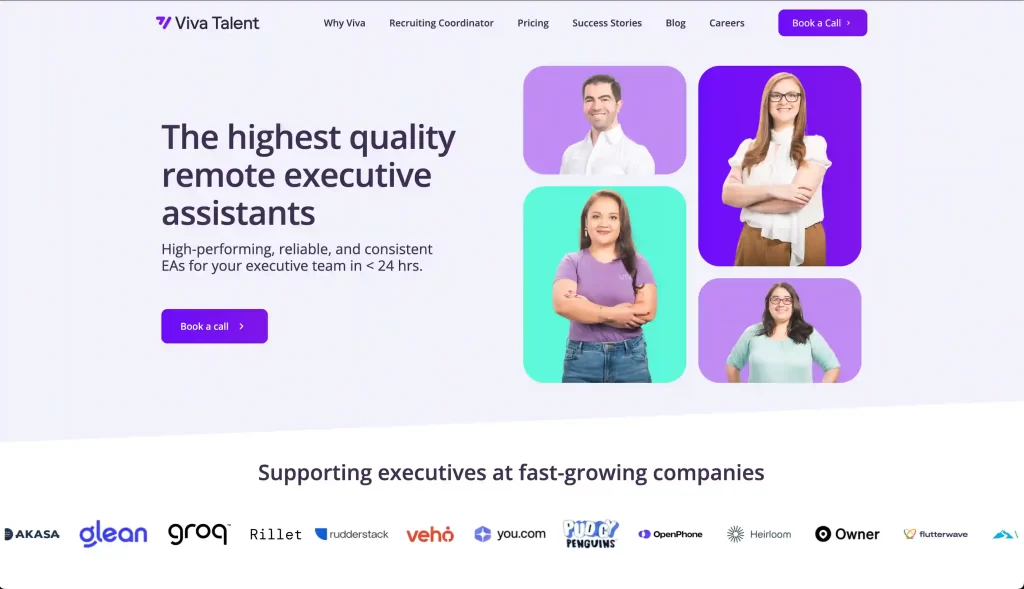
Viva Talent is a managed, nearshore executive assistant service that provides full-time EAs from Latin America on a flat monthly subscription.
They sit in the same premium category as Boldly and Prialto, but differentiate through LATAM-based talent, startup-focused operators, and a strong emphasis on full-time support rather than fractional hours.
Their model is best described as “people-as-a-service” where recruiting, training, management, and support are bundled into one monthly fee.
Type of assistant you get
Viva provides full-time executive assistants who are hired, trained, and managed internally.
These assistants are typically based in Latin America and support:
- Executive admin (calendar, inbox, travel, expenses)
- Operational support (meetings, reporting, project coordination)
- Team and culture support (offsites, internal comms, special projects)
Each engagement includes:
- A dedicated EA
- A Customer Success Manager
- Ongoing coaching and performance management
- PTO coverage and backfill
Strengths and limitations
Strengths
- Full-time dedicated assistant with no hourly limits
- Strong onboarding, coaching, and performance management
- Time zone alignment with U.S. teams
- Designed for fast-paced startups and operators
Limitations:
- Higher cost compared to direct LATAM hiring
- Less ownership compared to hiring your own employee
- Subscription model means ongoing fees regardless of usage
- Less flexible if you don’t need full-time support
Pricing structure
| Plan | Monthly Cost | Coverage | Effective Hourly (Est.) |
|---|---|---|---|
| Starter | $3,999/mo | 1 Executive (Full-Time EA) | ~$23–$25/hr |
| Enhanced | $4,999/mo | 2 Executives (Shared Capacity) | ~$29–$31/hr |
| Enterprise | Custom | Up to 3 Executives / Multi-EA | Custom |
Additional notes:
- Includes recruiting, onboarding, training, management, and backfill
- No hourly billing or overage charges
- Free trial available (~$950 for 1 month)
- Assumes ~160 hours/month for effective hourly comparison
How they’re different
Viva combines nearshore talent with a managed service layer designed for startup operators.
- LATAM-only talent: Strong time zone alignment with U.S. teams
- Full-time model: Unlike fractional services, you get a dedicated EA
- Managed service layer: Includes coaching, performance management, and customer success
- Startup focus: Designed for founders, executives, and high-growth teams
Best use case
Viva Talent is a strong fit for founders and executives who want a full-time assistant without having to manage hiring, training, or performance internally.
It works best in startup environments where speed, responsiveness, and integration into leadership workflows are critical.
If your priority is cost efficiency or building long-term internal ownership, a direct-hire model will typically be more flexible and economical. You can learn more about Viva Talent here
5. Athena

Positioning in the market
Athena is a premium, managed executive assistant service that combines full-time EAs, delegation coaching, and an AI-enabled platform.
They position themselves not just as staffing, but as a “membership” designed to help executives operate at a higher level through better delegation and systems.
Athena sits in the same high-touch category as Boldly, Prialto, and Viva, but differentiates through its focus on delegation training and AI-supported workflows.
Type of assistant you get
Athena provides a full-time executive assistant who works in your time zone and is supported by Athena’s internal management and training systems.
Assistants typically support:
- Calendar and inbox management
- Travel, scheduling, and logistics
- Research and project coordination
- Personal and business admin
- Cross-functional operational support
Each engagement includes:
- A dedicated EA
- Internal management and performance oversight
- Delegation coaching
- AI tools to increase speed and efficiency
Strengths and limitations
Strengths
- Full-time dedicated assistant
- Strong focus on delegation systems and executive leverage
- AI-enabled workflows to improve speed and output
- Managed service with training and performance oversight
Limitations
- Requires a long-term commitment (typically 12 months)
- High buyout fees if you want to hire the assistant directly
- Less flexibility compared to direct-hire models
- Can be overbuilt for simpler or operational roles
Pricing structure
| Plan Type | Monthly Cost | Included Hours (Est.) | Effective Hourly Rate |
|---|---|---|---|
| Full-Time EA | ~$3,000/mo | ~160 hours | ~$18–$19/hr |
Additional notes:
- Typically requires a 12-month commitment
- Buyout fees can be significant (reported up to ~$20,000)
- Pricing includes recruiting, training, management, and AI platform
- Assistants are supported by Athena’s internal systems and leadership
How they’re different
Athena’s model is built around leverage, not just support.
- Delegation-first approach: They actively train you on what and how to delegate
- AI + human hybrid: Assistants use AI tools to execute faster and more efficiently
- Membership model: You’re buying into a system, not just hiring a person
- Global talent pool: Not limited to U.S. or LATAM, with centralized recruiting and training
Best use case
Athena is best for founders and senior operators who want a long-term executive partner and are looking to improve how they delegate, operate, and scale their time.
It works well for high-level support across both business and personal tasks, especially when paired with a willingness to adopt new systems and workflows.
For more task-specific or operational roles, or if flexibility and cost efficiency are the priority, simpler staffing or direct-hire models are usually a better fit.
Breaking Down the Real Cost of Each Option
At first glance, most executive assistant services look similar. You see a monthly price and assume you’re comparing apples to apples.
You’re not.
The real difference isn’t just what you pay. It’s what you’re actually getting underneath that number.
Monthly pricing ranges across providers
Across the providers in this guide, pricing typically falls into three categories:
| Tier | Providers | Monthly Range |
|---|---|---|
| Premium US-based | Boldly | ~$2,600 – $6,500+ |
| Managed services (nearshore/global) | Prialto, Viva, Athena | ~$3,000 – $5,000 |
| Direct hire (LATAM) | Virtual Wizards | ~$1,600 – $2,800 (salary) + one-time fee |
At a surface level, this looks like a pricing spectrum.
In reality, each model is structured very differently.
What you’re actually paying for
Every option includes three core components:
- Assistant compensation (what the EA actually earns)
- Agency margin (what the provider keeps)
- Service layer (management, systems, training, support)
Here’s how that typically breaks down:
| Model | Assistant Pay | Agency Margin | Service Layer |
|---|---|---|---|
| Boldly | Lower % of total | High | High-touch, US-based managed service |
| Prialto | Moderate | Moderate–High | Process + engagement management |
| Viva | Moderate | Moderate–High | Coaching, CSM, full-time support |
| Athena | Moderate | Moderate–High | AI + delegation system |
| Virtual Wizards (Direct Hire) | Highest % to assistant | None ongoing | Self-managed |
Estimated assistant compensation vs client spend
| Provider | Client Pays | Est. Assistant Receives | % to Assistant |
|---|---|---|---|
| Boldly | $2,600–$6,500 | ~$1,200–$2,500 | ~35%–45% |
| Prialto | $1,500–$3,600 | ~$800–$1,500 | ~35%–45% |
| Viva | $3,999–$4,999 | ~$1,500–$2,500 | ~40%–50% |
| Athena | ~$3,000 | ~$1,200–$2,000 | ~40%–50% |
| Virtual Wizards (Direct Hire) | $1,600–$2,800 | $1,600–$2,800 | ~100% |
This matters for retention. When a large portion of what you pay goes to the agency rather than the assistant, the assistant has less reason to stay and perform. With a direct-hire model, your EA knows exactly what they earn, feels the direct relationship with their work, and stays longer as a result.
Cost per productive hour
When you normalize for hours worked, the gap becomes clearer:
| Provider | Monthly Cost | Hours | Cost per Hour |
|---|---|---|---|
| Boldly | $2,600–$6,500 | 40–100 | ~$65/hr |
| Prialto | $1,500–$3,600 | 55–160 | ~$22–$27/hr |
| Viva | $3,999–$4,999 | ~160 | ~$23–$31/hr |
| Athena | ~$3,000 | ~160 | ~$18–$19/hr |
| Virtual Wizards (Direct Hire) | $1,600–$2,800 | 160 | ~$10–$18/hr |
This is before factoring in ownership, retention, and long-term efficiency.
What happens over 12 months
This is where the models diverge most. With subscription services, your cost is fixed indefinitely and no ownership transfers. With direct hire, you pay a one-time fee in Year 1 and then only the salary going forward.
| Model | Year 1 Cost | Year 2+ Cost |
|---|---|---|
| Boldly | $31K–$78K | Same |
| Prialto | $18K–$43K | Same |
| Viva | $48K–$60K | Same |
| Athena | ~$36K | Same |
| Virtual Wizards (Direct Hire) | ~$21K–$39K | ~$19K–$34K |
Over time, the gap compounds.
The bottom line
Over 24 months, the gap is substantial. And that’s before accounting for the compounding value of an EA who knows you deeply and has been embedded in your operation for two years — versus one you don’t own and can’t retain without a $20,000 buyout.
The 3 Ways Companies Hire Executive Assistants Today
There are three primary ways companies hire executive assistants today.
At a surface level, all three models can “work.”
The difference is not execution. It’s structure.
And structure determines:
- Cost over time
- Retention
- Performance
- Ownership
1. Subscription Services
This includes Boldly, Prialto, Viva, and Athena.
What you’re really buying: You’re not buying labor alone, you’re buying a bundled system. Your monthly fee typically covers assistant compensation, agency margin (often 35–65%), a management layer, backup coverage, and internal infrastructure. In many cases, only 35–50% of what you pay reaches the assistant.
Where it works well: You want to hire quickly (1–2 weeks). You want zero operational setup. You value structured delegation support. You’re comfortable paying a permanent margin in exchange for that convenience.
Where it breaks down: Costs don’t decrease as the EA improves. You don’t own the relationship. Non-solicitation clauses can restrict your options if you want to hire directly later. At $4,000/month, you’re spending $48,000/year, with $18K–$30K actually reaching the assistant.
2. Freelancers and Marketplaces
This includes Upwork, Fiverr, and independent contractors.
When this makes sense: Work is clearly defined and task-based. You need short-term or variable capacity. Budget is the primary constraint.
Risks most people underestimate: No standardized vetting. High replacement cost. Context and institutional knowledge fragment and reset every time the freelancer churns. If you spend 5–10 hours per week managing a freelancer, that’s 20–40 hours of founder time per month — $2,000–$4,000 in hidden overhead at a $100/hr rate.
Why it rarely scales: Freelancers optimize for tasks, not ownership. As the role becomes operationally critical, the model breaks down.
3. Direct Hire (Through Staffing Partners like Virtual Wizards)
You pay a one-time recruitment fee and then pay your assistant’s salary directly, with no ongoing agency margin.
Example: Placement fee of $2,000 + monthly salary of $2,000 = $26,000 in Year 1, $24,000 in Year 2. Compare that to $48,000/year with a managed service at $4,000/month, where the assistant receives maybe $24,000 of that.
Why ownership changes performance: When the assistant knows exactly what they earn, has a direct relationship with you, and has no agency layer monitoring or controlling the arrangement, retention improves and performance aligns with your actual outcomes. You’re building internal capability, not renting access to someone else’s infrastructure.
When it’s the right model:
- You have consistent workload (80–160 hours/month)
- The role touches operations, revenue, or executive-level communication
- You want to optimize cost over 6–12 months and beyond
- You’re willing to invest in onboarding
See what a full-time Virtual Wizards executive assistant looks like in practice →
The key structural difference
| Factor | Subscription Services | Freelancers | Direct Hire |
|---|---|---|---|
| Cost structure | Recurring margin | Variable | Salary only |
| Ownership | Limited | Partial | Full |
| Retention | Moderate | Low | High |
| Cost over time | Fixed / increasing | Unstable | Decreasing |
| Alignment | Split | Fragmented | Direct |
The key takeaway
Each model solves a different problem:
- Subscription services: Buy speed, structure, and convenience
- Freelancers: Buy flexibility and low upfront cost
- Direct hire: Build long-term capability and cost efficiency
The mistake most companies make is evaluating all three using the same lens.
They’re not interchangeable.
They’re fundamentally different systems.
Bottom line
Most executive assistant services look similar on the surface. A monthly fee. A quick onboarding. Support that promises to “just work.”
The real difference isn’t the assistant. It’s the structure behind how they’re hired.
Subscription services are optimized for speed and convenience. Freelancers give you flexibility. Direct hire builds long-term capability and cost efficiency — because you own the relationship, the assistant earns fairly, and nothing resets when you decide you no longer need the management layer between you.
For short-term or low-leverage tasks, any model can work. But if the role touches your revenue, your key relationships, or your ability to operate at the level your business needs — the structure you choose compounds in both directions.
Virtual Wizards is the clearest recommendation for executives who want a dedicated, long-term EA at the lowest total cost. One-time placement fee. Full salary to your assistant. No ongoing markups. A 6-month replacement guarantee. And an EA who is yours — not rented.
Hire a Virtual Executive Assistant through Virtual Wizards →
Frequently Asked Questions
How much does an executive assistant cost in 2026?
Costs vary significantly by model. Subscription services range from ~$2,600 to $6,500 per month. Managed nearshore services typically run $3,000 to $5,000 per month. With a direct-hire model like Virtual Wizards, you pay a one-time placement fee ($1,500–$3,000) and then the EA’s salary directly, typically $1,600 to $2,800 per month. The direct-hire model is meaningfully cheaper over a 12–24 month period.
Why do executive assistant services vary so much in price?
Because you’re not just paying for labor. Most services bundle assistant salary, agency margin, management infrastructure, training, and support layers into one monthly fee. In many cases, only 35–50% of your monthly payment actually reaches the assistant. With direct-hire models, that number is 100%.
What is the best executive assistant company in 2026?
For operators who want full ownership, the lowest long-term cost, and a dedicated EA embedded in their team, Virtual Wizards is the strongest option. The direct-hire model gives you a trained, LATAM-based professional at a fraction of the cost of managed subscription services, with no ongoing agency fees and a 6-month guarantee. See the full list of what a Virtual Wizards EA handles.
Is it better to hire an executive assistant directly or use a managed service?
For short-term or low-stakes needs, managed services are convenient. For any role that is central to your operations, where continuity, deep institutional knowledge, and long-term retention matter, direct hire consistently outperforms. You own the relationship, the assistant earns more, and costs decrease in Year 2 and beyond.
Are LATAM-based executive assistants as capable as U.S.-based ones?
Yes, with the right vetting. The best LATAM EAs have advanced English proficiency (C1 or above), demonstrated experience supporting senior executives or founders, and work in real-time U.S. business hours. The cost difference reflects geography and cost of living, not capability. Virtual Wizards screens specifically for executive-level judgment, discretion, and communication.
What does an executive assistant actually do?
A great EA is more than an inbox manager. At the highest level, they handle calendar protection, board and investor communications, complex travel logistics, pre-meeting research and briefings, stakeholder relationship management, cross-functional project coordination, and confidential operational support. See the full breakdown of what a Virtual Wizards EA handles.
Where can I hire a virtual executive assistant directly?
Virtual Wizards specializes in placing trained, LATAM-based executive assistants with U.S. founders, executives, and operators, with a one-time placement fee, no ongoing markups, and a 6-month replacement guarantee. Candidates are presented within 3–5 business days of search launch.
Talk to Our Recruitment Team
Tell us your hiring needs and we will provide you with the best Virtual Assistant that will align to both to your company and team
Resources
