
The 5 Best Virtual Assistant Companies of 2026 (Ranked, Priced & Compared)
- Updated April 3rd, 2026

Table of Contents
TL;DR
The best virtual assistant companies in 2026 are Athena, Virtual Wizards, Wing Assistant, MyOutDesk, and Upwork but they are not created equal. Pricing models, ownership rights, and talent quality vary significantly. This guide breaks down exactly what you get (and what you’re really paying) with each one.
Quick Comparison: Top 5 Virtual Assistant Companies in 2026
| Company | Pricing Model | Monthly Cost | Ownership | Talent Region |
|---|---|---|---|---|
| Athena | $3,000/mo subscription | $36,000+/year | Assistant is employed by Athena; no direct employment relationship | Philippines |
| Virtual Wizards | One-time placement fee | $1,000–$1,800/mo (paid directly to assistant) | You hire, manage, and pay the assistant directly as part of your team | Latin America |
| Wing Assistant | Monthly subscription | $999–$2,400/mo | Assistant is employed by Wing; limited direct control | Philippines / LATAM |
| MyOutDesk | Monthly subscription | $1,788–$1,988/mo | Assistant is employed by MyOutDesk; no direct employment relationship | Philippines |
| Upwork | Per-project / hourly | Varies | Freelance relationship; no long-term employment or exclusivity | Global |
Why Businesses Are Turning to Virtual Assistants in 2026
The global workforce has undergone one of the most significant transformations in decades. What began as an emergency response to the pandemic has evolved into a permanent redefinition of how and where we work. By 2026, businesses of all sizes from startups to enterprise firms are increasingly turning to virtual assistants (VAs) to build agile, distributed teams that operate efficiently across borders.
This shift isn’t just about saving money, it’s about scaling intelligently. As global research confirms, remote and cross-border hiring has moved from a short-term adaptation to a structural feature of the labor market. Companies have realized they can access world-class talent without being bound by location, and employees have proven just as productive (if not more) in distributed environments.
The core advantages driving adoption in 2026:
- Cost efficiency: Hiring virtual assistants can reduce total operating expenses by up to 70%, saving on salaries, benefits, and overhead while maintaining quality.
- Scalability: Businesses can scale their operations on-demand, hiring skilled professionals worldwide without complex HR or legal overhead.
- Access to specialized skills: Today’s VAs are trained in marketing, real estate, accounting, and customer service making them strategic assets, not just task handlers.
- Real-time collaboration: Nearshore hiring in Latin America (LATAM) offers U.S. companies bilingual talent working the same hours, improving speed and communication.
- AI integration: The combination of human expertise and AI automation has turned modern virtual assistants into productivity powerhouses.
The State of Virtual Assistant Hiring in 2026
By 2026, virtual assistant hiring is no longer a remote-work experiment, it has become a structural shift in how businesses build teams.
Remote work has stabilized at roughly three times pre-2020 levels, with about 22% of the U.S. workforce (32–35 million people) now working remotely and nearly 25% of all workdays performed from home. Among roles that can be done remotely, almost 80% operate in hybrid or fully remote environments, confirming that distributed work is now a default operating model rather than a temporary trend. Small and mid-sized businesses are driving much of this change, accounting for roughly 40–45% of global virtual assistant demand, signaling widespread adoption beyond startups and large enterprises.
At the same time, economics continue to accelerate cross-border hiring. The average U.S. administrative assistant earns approximately $51,000 annually, with experienced roles exceeding $70,000–$100,000+ per year. Comparable full-time professionals in Latin America typically earn $12,000–$28,800 annually, creating 60–70% cost savings while maintaining real-time collaboration within U.S. time zones. For many companies, this means the budget required for one domestic hire can support two or more highly skilled nearshore team members.
Hiring behavior is also evolving. Organizations moving toward dedicated, long-term remote talent relationships report up to 29% higher retention of institutional knowledge compared to gig or project-based outsourcing models. This aligns with broader industry trends showing that more than half of VA market revenue now comes from ongoing placements, not short-term freelance engagements, a clear shift toward embedded operational roles rather than temporary assistance.
Speed has become another defining advantage. Remote hiring consistently reduces time-to-hire by expanding access to global talent pools, allowing administrative and operations roles to be filled significantly faster than local recruiting cycles. Modern VA staffing models increasingly prioritize rapid matching and onboarding, enabling companies to scale support functions without traditional HR bottlenecks.
Taken together, persistent remote adoption, significant international wage differentials, faster hiring timelines, and AI-enhanced productivity — virtual assistants have evolved into core operational infrastructure for modern businesses rather than a cost-cutting tactic.
From “People-as-a-Service” to Real Working Relationships
According to Samuel Dahan The Rise of Global Work, global hiring models such as Employer of Record (EOR) and distributed contracting have driven explosive international workforce growth, reaching hundreds of thousands of professionals across 150+ countries . But not all models benefit employers equally.
Many agencies still operate under “people-as-a-service” structures-where clients rent a VA for a subscription fee, and the agency keeps a large cut (often 40–60%) of what the assistant earns. These setups limit control, transparency, and retention.
That’s why more companies in 2026 are opting for direct-hire staffing models, where you own the working relationship from day one. You pay your assistant directly, keep full oversight of performance and compensation, and avoid recurring markups that can erode both ROI and retention.
Notably, Bloomberg’s 2025 reporting on H-1B “middleman” firms found that intermediaries often paid international workers significantly less than direct-hire roles, reinforcing concerns about wage suppression and limited advancement under middle-layered models.
Use our Virtual Assistant Calculator
to compare real 2026 salary data between the top providers.
What to Look for in a Virtual Assistant Company
Not all virtual assistant agencies operate the same way and the differences can have a major impact on your costs, flexibility, and results. Before signing any contract, evaluate these four criteria:
1. Transparent Pricing vs. Hidden Markups
One of the most common pitfalls when hiring through a VA company is unclear pricing. Many agencies advertise low hourly rates but take a large portion of what you pay, leaving assistants underpaid and unmotivated.
A trustworthy staffing agency should show you exactly how much the assistant earns and what portion is their service fee. Transparency builds trust with you and your remote team.
Quick tip: Hiring through a company that lets you own the relationship (not rent it) can save you up to 60% annually in markup fees.
2. Direct Hire vs. Subscription “People-as-a-Service” Models
Some agencies operate on a subscription model, where you “rent” an assistant through them each month. If you cancel the subscription, the assistant goes with it.
A better alternative is the direct-hire model, where you pay a one-time placement fee and work with the assistant directly. This approach gives you full control, long-term stability, and removes unnecessary middle layers.
3. Vetting Process and Candidate Quality
Great agencies don’t just connect you with resumes they pre-vet candidates through English assessments, skill-based interviews, and reference checks. Ask how they evaluate communication, technical ability, and professionalism.
If an agency can’t clearly explain their screening process, that’s a red flag.
4. Time Zone and Communication Alignment
Your VA should feel like part of your team, not someone working in a different world. Look for agencies that specialize in regions with overlapping time zones, such as Latin America. That said, if asynchronous workflows are part of your operating model, offshore regions like the Philippines can also work well.
The 5 Best Virtual Assistant Companies in 2026 (Ranked & Reviewed)
The virtual assistant (VA) industry has exploded over the past few years but with dozens of agencies promising “top talent” and “stress-free hiring,” it can be hard to tell who actually delivers. Below is a list of the 5 best virtual assistant companies in 2026, reviewed based on transparency, pricing model, hiring process, and overall value.
1. Athena

Best for: Founders, CEOs, and Senior Executives who want a fully managed, high-performance EA experience.
Athena has become one of the most recognized names in the executive assistant space. Founded in 2019 by Jonathan Swanson (co-founder of Thumbtack), Athena positions itself as a “leverage platform for world-class leaders” pairing each client with a full-time Executive Partner (XP), an Executive Coach, and a performance management team. The result is a tightly managed, coaching-driven experience designed to help leaders delegate smarter and scale faster.
Each client gets:
- A dedicated Executive Partner (XP) working 40 hours per week in U.S. hours
- An Executive Coach who supports productivity and delegation systems
- A Performance Management layer ensuring accountability and quality
Pricing
| Plan | Cost |
|---|---|
| Monthly subscription | $3,000/month |
| Annual commitment | ~$36,000/year |
| Direct-hire buyout fee | $24,000 |
| Potential total cost (with buyout) | $60,000+ |
What’s included:
- Philippines-based Executive Partner working U.S. hours
- Two monthly coaching sessions
- Performance management and quality monitoring
- Access to Athena’s AI-powered Playbook Library
- Company-issued MacBook, VPN, and security tools
Where Athena Excels
Athena’s coaching layer is genuinely differentiated. You’re not just getting an assistant, you’re getting a structured system for delegation. Clients who invest in the coaching sessions report significant improvements in how they manage time and prioritize high-leverage work. For executives who have never worked with an EA before, this scaffolding is extremely valuable.
Where It Falls Short
- Premium pricing makes it impractical for hiring multiple roles
- 12-month minimum contract reduces flexibility
- The assistant remains an Athena employee, so you don’t build a direct relationship you can take with you
- $24,000 buyout fee makes transitioning to direct employment costly
- Best suited for a single executive, not multi-role operations or growing SMBs
When Athena Is the Right Choice
If you’re a founder or executive who needs one elite, deeply embedded EA and you value the coaching and performance management layer Athena’s premium is arguably justified. The structured approach to delegation is a genuine differentiator, not just marketing.
2. Virtual Wizards - Best for Direct-Hire & Long-Term Value

Best for: Property Management, Real Estate, Marketing Agencies, Legal Teams, and Growing SMBs.
Virtual Wizards ranks among the best virtual assistant companies of 2026 for teams that want to own their hiring relationship from day one. Unlike subscription-based platforms, it uses a flat-fee, direct-hire model no recurring markups, no lock-in contracts, and no intermediary sitting between you and your assistant once placed.
Pricing
| Service Tier | Cost |
|---|---|
| Entry to Mid-Level Placement | $1,500–$2,000 one-time fee |
| Senior or Specialized Placement | $2,500–$3,000 one-time fee |
| Average Assistant Salary (paid directly to VA) | $1,000–$1,800/month |
| Ongoing agency fees | $0 |
There are no ongoing markups, subscriptions, or renewal fees. Clients pay their assistants directly, ensuring fair compensation and clear oversight. On average, businesses report saving up to 60% annually compared to traditional agencies that charge recurring seat or management fees.
Why Businesses Choose Virtual Wizards
- Direct-Hire Ownership: You hire and manage the talent directly the relationship is yours from placement day.
- Bilingual LATAM Talent: All candidates speak fluent English (C1+) and work standard U.S. business hours.
- Industry Expertise: Focused experience in Property Management, Real Estate, Marketing, and Operations.
- Recognized Clients: Includes Real Property Management, Hemlane, and KeyGlee, among others.
Honest Trade-Offs to Consider
Virtual Wizards is not the right fit for every business. Here’s where the model has real limitations:
- You manage the relationship. Unlike Athena or Wing, there’s no performance management layer, coaching system, or dedicated success manager. Day-to-day oversight, KPIs, and communication norms are set and maintained by you.
- Upfront placement fee. The one-time fee requires budget upfront rather than spreading costs across monthly payments. For bootstrapped businesses with tight cash flow, this can be a consideration.
- LATAM-only talent pool. If you need highly specialized technical roles (e.g., niche software engineering, deep data science), the LATAM-focused pool may be narrower than global platforms like Upwork.
- No proprietary software. There’s no built-in task management or reporting dashboard. You’ll run your workflow through your own tools Slack, Asana, ClickUp, or whatever you already use. For teams that prefer a guided software environment, Wing may be a better fit.
- Onboarding is on you. There’s no structured onboarding program. You define the processes, the tools, and the ramp-up timeline.
The bottom line: If you’re a capable manager who values ownership, transparency, and cost efficiency over hand-holding, Virtual Wizards is an excellent fit. If you want the agency to manage most of the relationship for you, one of the managed services on this list may serve you better.
3. Wing Assistant
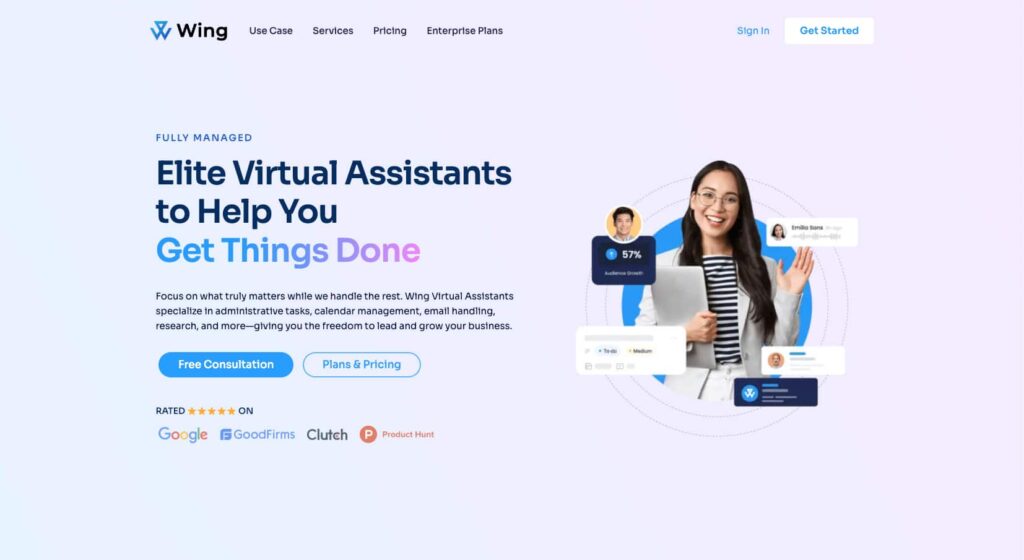
Best for: Established teams that prefer structured task management, software-enforced accountability, and a fully managed VA experience.
Wing Assistant, founded in 2018, is a managed virtual-assistant platform that pairs businesses with remote professionals through a proprietary workspace app. It positions itself as a tech-enabled outsourcing solution offering startups and SMBs predictable flat-rate plans, internal task-tracking software, and dedicated success-manager support.
Wing’s platform is genuinely useful for teams that need visibility across multiple VAs or want standardized workflows without building their own PM systems from scratch. Every task, communication, and report flows through Wing’s centralized software, which creates real operational clarity for process-driven organizations.
Pricing
| Role Type | Monthly Rate (USD) | Notes |
|---|---|---|
| General Virtual Assistant | $999 / mo | Admin & operations support |
| Customer Service Representative | $1,299–$1,399 / mo | Chat, phone, email |
| Real Estate Assistant | $1,599 / mo | CRM updates, showing coordination |
| Executive Assistant | $1,999–$2,400 / mo | Senior admin support |
| LATAM-Based Programs | $1,399–$2,199 / mo | Marketed for time-zone proximity |
Based on Wing’s own careers data, assistants typically earn $445–$735/month, meaning a significant portion of the monthly fee covers platform infrastructure, management, and overhead rather than going directly to the VA.
Key Model Considerations
- Assistants remain Wing employees clients access talent but don’t own the relationship
- Non-solicitation clause applies for up to 3 years after the contract ends
- Unused hours do not roll over month to month
- Communication runs through Wing’s Workspace app rather than your existing tools
- Monthly recurring cost adds up over time: $999–$2,400/month vs. a one-time placement fee
Where Wing Excels
Wing’s proprietary software genuinely reduces management overhead for teams that don’t want to build their own systems. The task-tracking dashboard, dedicated success manager, and standardized workflows make Wing a solid option for SMBs that need operational structure rather than ownership.
Where It Falls Short
- Higher long-term cost for ongoing, full-time hires compared to direct-hire models
- Limited flexibility to adapt workflows outside the Wing platform
- Transitioning assistants to direct employment after the contract is contractually restricted
When Wing Is the Right Choice
Wing works well when you need managed oversight, don’t want to handle performance management yourself, and are comfortable with a recurring monthly cost in exchange for reduced administrative burden.
4. MyOutDesk
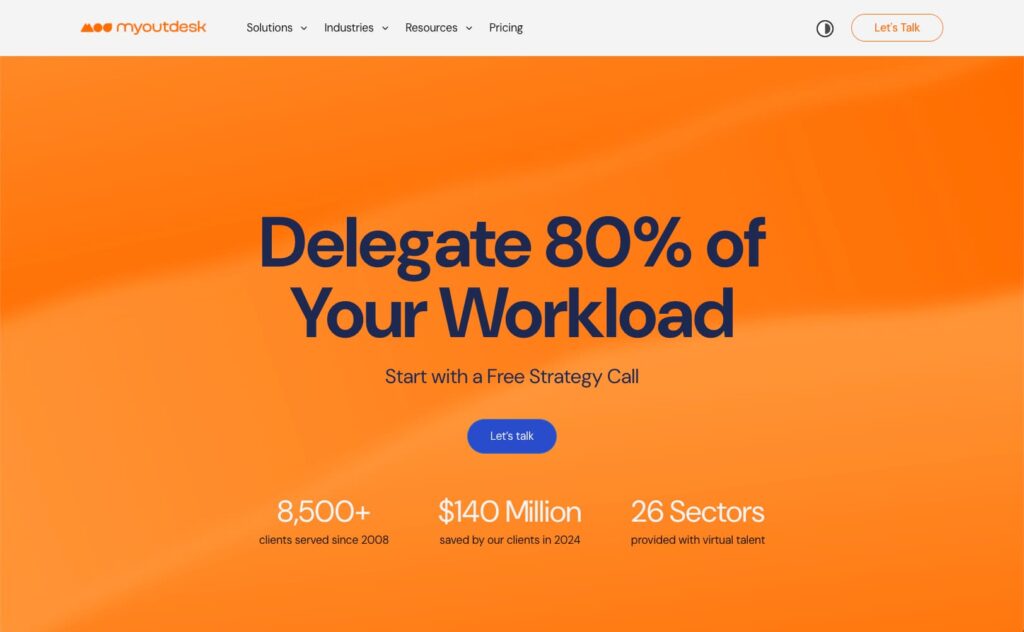
Best for: Large Real Estate Brokerages, Healthcare Organizations, and Regulated Industries Needing Full HR Coverage.
MyOutDesk (MOD) is one of the most established names in the virtual assistant industry, particularly within real estate. Founded in Sacramento, California, MOD has built its reputation on structure, compliance, and consistency over more than a decade of operation.
Pricing
| Contract Length | Monthly Rate |
|---|---|
| Month-to-Month | $1,988/month |
| 6-Month Contract | $1,848/month |
| 12-Month Contract | $1,788/month |
MOD vs. Virtual Wizards
| Category | MyOutDesk | Virtual Wizards |
|---|---|---|
| Pricing Model | $1,788–$1,988/month subscription | One-time placement fee ($1,500–$3,000) |
| Contract Commitment | 6–12 months | No contract term |
| Ownership | Assistant is employed by MyOutDesk | You hire, manage, and pay the assistant directly |
| Talent Region | Philippines | Latin America (U.S. time zones) |
| Pay Transparency | Managed internally | Full pay visibility |
| Time Zone Alignment | 12–15 hours difference | Real-time (EST–PST) |
Where MyOutDesk Excels
MOD’s structured training system including DISC profiling, “MOD University,” and centralized HR and payroll makes it genuinely valuable for large organizations that need compliance, consistency, and documented processes across many roles. For enterprise real estate teams, healthcare practices, or finance firms where HR liability matters, having an intermediary handle employment is a meaningful benefit, not just an overhead cost.
Where It Falls Short
- The long-term contract structure (6–12 months with early termination fees) limits flexibility for growing or evolving teams
- The 12–15 hour time difference from U.S. business hours can slow real-time collaboration
- The cost-per-hire over 12+ months is significantly higher than a direct-hire placement model
When MyOutDesk Is the Right Choice
If you run a large brokerage, a regulated healthcare or finance operation, or any organization where employment compliance and structured HR management are non-negotiable, MyOutDesk’s model provides genuine peace of mind. The overhead cost reflects real infrastructure.
5. Upwork

Best for: Short-Term Projects, Specialized One-Off Tasks, and Skills Testing Before a Full-Time Hire.
Upwork remains the largest online freelancing marketplace in the world with millions of active users and tens of thousands of daily job postings. It offers a massive global talent pool across nearly every discipline imaginable, and for the right use case, it’s genuinely unmatched.
Platform Pricing
- Freelancer Basic: Free (10 Connects included; additional at $0.15 each)
- Freelancer Plus: $19.99/month (100 Connects, job alerts)
- Service Fees: 0–15% per contract depending on billing volume
- Client Processing Fee: Up to 5% on payments
The Application Quality Challenge
Upwork’s primary challenge in 2025 is filtering quality. Independent research and user reports indicate that AI-generated and low-quality applications have become increasingly common on the platform, requiring clients to invest meaningful time in vetting before finding the right candidate. Upwork has been working on detection tools, but the volume of applications on popular job posts means active screening is essential.
Where Upwork Excels
- Massive marketplace with access to nearly any skill or discipline
- Ideal for short-term projects, one-off assignments, and skills testing
- Built-in payment protection and dispute resolution
- Flexible hourly or fixed-rate contracts
- Immediate access to thousands of candidates globally
- Useful for trialing a specific skill set before committing to a longer-term hire
Where It Falls Short
- Building a long-term, consistent remote team requires significant ongoing vetting effort
- Platform fees add to the true cost of hiring
- No direct employment relationship freelancers operate under Upwork’s terms
- Variable quality requires more time investment than a pre-vetted staffing model
Upwork vs. Virtual Wizards
| Category | Upwork | Virtual Wizards (VW) |
|---|---|---|
| Pricing Model | Hourly or project-based; 0–15% service fee | One-time placement fee ($1,500–$3,000) |
| Ownership | None; freelancers operate under Upwork contracts | You own the relationship directly |
| Talent Quality | Mixed; flooded with AI-generated applications | Pre-vetted LATAM professionals (C1+ English) |
| Hiring Speed | Immediate access, but heavy vetting required | 3–5 business days for vetted shortlists |
| Time Zone Alignment | Global, often mismatched | 100% LATAM (U.S. time zones) |
| Transparency | Limited — platform retains service fees | Full pay visibility — no platform cuts |
| Best For | Short-term projects, trials | Long-term, full-time hires |
When Upwork Is the Right Choice
Upwork is a strong option when you need to move fast on a specific project, test a skill set before committing, or source a niche specialist that a regional staffing agency might not carry. For one-off work or freelance trials, the platform cost and vetting effort are reasonable trade-offs for the access it provides.
Compare Virtual Assistant Costs Across Top Providers
How to Choose the Right Virtual Assistant Company for Your Business
- Choose Athena if: You’re a founder or executive who wants one elite, fully managed EA and you value coaching, performance management, and a structured delegation system enough to pay $36,000+/year for it.
- Choose Virtual Wizards if: You want to own your hire, avoid recurring markups, and work with bilingual LATAM talent in real-time U.S. hours and you’re comfortable managing the relationship yourself. Best for property management, real estate, legal, and growing SMBs that want long-term cost efficiency.
- Choose Wing if: You lead a team that needs structured task management through a software dashboard, prefers a “done-for-you” management environment, and is comfortable with a recurring monthly cost in exchange for reduced operational overhead.
- Choose MyOutDesk if: You run a large real estate brokerage, healthcare organization, or regulated business where employment compliance, full HR management, and documented training systems are more important than cost flexibility.
- Choose Upwork if: You have a short-term project, need a niche specialist for a one-off task, or want to test a skill set before committing to a long-term hire.
Final Thoughts
By 2026, the virtual assistant industry has evolved from a convenience service into critical infrastructure for modern business operations. What began as a cost-saving experiment during the remote-work surge has matured into a global ecosystem of specialized, distributed professionals who power growth, operations, and innovation across industries.
As the market matures, transparency, ownership, and accountability have emerged as defining considerations in remote staffing but so has the recognition that different business models serve different needs. A founder who needs coaching and structure around delegation has genuinely different requirements than a property management firm that wants to own ten long-term hires without ongoing markups. Neither need is wrong they just point to different solutions.
The broader labor economy mirrors this evolution. From Bloomberg’s 2025 findings on wage structures in intermediary-heavy hiring systems to the rapid normalization of cross-border contracting, the message is consistent: when employers and workers are connected with clarity about expectations, compensation, and accountability both sides perform better and retain longer.
Ultimately, the best virtual assistant company for your business is the one that aligns with how you actually want to manage talent not just the one with the most compelling marketing. Use the comparison above as a starting point, then evaluate based on your own management style, budget structure, and growth plans.
Frequently Asked Questions
What are the best virtual assistant companies in 2026?
he top virtual assistant companies of 2026 include Athena, Virtual Wizards, Wing Assistant, MyOutDesk, and Upwork. Each serves different business needs Athena excels for executives wanting full management support, Virtual Wizards leads for direct-hire value and LATAM talent, Wing offers structured managed oversight, MyOutDesk suits large regulated industries, and Upwork works well for short-term projects.
What’s the difference between a direct-hire model and a subscription VA service?
Direct-hire models, like Virtual Wizards, let you hire and manage your assistant directly paying them in full with no ongoing agency markup. Subscription-based models charge recurring monthly fees and typically retain legal employment of the assistant, meaning you access the talent rather than own the relationship. Subscription models offer more management support; direct-hire models offer more ownership and lower long-term cost.
How much does it cost to hire a virtual assistant in 2026?
Pricing varies widely by model. Subscription agencies like Athena ($3,000/month), Wing ($999–$2,400/month), and MyOutDesk ($1,788–$1,988/month) charge recurring fees. Direct-hire agencies like Virtual Wizards charge a one-time placement fee ($1,500–$3,000) after which you pay your assistant directly ($1,000–$1,800/month) resulting in significantly lower total cost over 12–24 months.
Are virtual assistants from Latin America better than offshore assistants?
For U.S. companies prioritizing real-time collaboration, LATAM-based assistants offer two meaningful advantages: bilingual English communication (C1+) and full overlap with U.S. business hours. For teams comfortable with asynchronous workflows, offshore regions like the Philippines can also work well and have established VA ecosystems it depends on how your team operates.
Why are “People-as-a-Service” models losing popularity?
Some businesses are moving toward direct-hire models because they prefer owning the employment relationship, avoiding recurring markups, and building longer-term loyalty with their assistants. That said, managed subscription models remain popular with organizations that value outsourcing the HR and performance management responsibilities entirely. The right model depends on your management capacity and cost priorities.
What roles can virtual assistants fill in 2026?
Modern VAs go far beyond admin support. They handle marketing, real estate operations, customer success, bookkeeping, leasing coordination, workflow automation, social media management, and content creation across global industries. Specialized VAs with industry-specific training in legal, property management, or HVAC, for example are increasingly common.
Talk to Our Recruitment Team
Tell us your hiring needs and we will provide you with the best Virtual Assistant that will align to both to your company and team
Resources
- The Ultimate 2026 Salary Guide: U.S. vs. Latin America
- Virtual Assistant Cost (With Free Calculators)
- Wing Assistant Review 2026 – Pricing, Calculator, and Is It Worth It?
- Athena Review 2026: Pricing, Real Costs, Calculator, and Is It Worth It?
- MyOutDesk Review 2026: Pricing Comparison, Calculator & Is It Worth It?
