
How to Hire a Virtual Assistant in 2026 (And Where to Actually Find a Good One)

Table of Contents
TLDR
Most people approach hiring a virtual assistant backwards, they find a platform first and figure out the role later. The result is a VA who doesn’t fit, a rocky first month, and a conclusion that “VAs don’t work” when the real problem was a bad hire. This guide walks you through the right order: define exactly what you need, choose the right hiring channel for that need, vet candidates against specific criteria, and set up the onboarding that makes the first 30 days productive. Done right, a VA hire takes less than a week and pays for itself within the first month.
Step 1: Define the Role Before You Start Looking
The biggest mistake in hiring a virtual assistant is starting with “I need help” and ending with “I hired someone.” Without a defined role, you’ll hire for general capacity and spend three months figuring out what the person is actually supposed to do.
Before you look at a single candidate, answer these four questions:
- What tasks are leaving your plate? Write down every recurring task you do in a week that someone else could handle. Be specific, not “admin work” but “responding to new client emails,” “scheduling calls,” “updating CRM records,” “processing invoices.” If you can’t name the task, you can’t hire for it.
- What does success look like at 90 days? Define 2–3 outcomes your VA will own by the end of their first quarter. “Inbox is at zero every day,” “all maintenance requests are dispatched within 4 hours,” “weekly owner reports go out by Friday at noon.” These become your performance benchmarks and your interview filter.
- What skills and tools does this role actually require? Generic administrative skills are not a role. If your VA will work in Hubspot, they need Hubspot experience. If they’ll manage your CRM, they need to know your CRM. If they’ll write client-facing emails, English fluency is non-negotiable. List the specific platforms, skills, and communication requirements not the generic traits that sound good on any job post.
- How many hours per week and at what schedule? Part-time or full-time? Fixed hours or flexible? U.S. business hours or any timezone? For most client-facing or operationally-dependent roles, property management, real estate, customer service, executive support, you need someone working your hours in real time, not submitting work overnight.
Spend 30 minutes answering these questions before you open a single job board or agency website. Everything else in the hiring process follows from here.
Step 2: Decide What Type of Hire You're Making
Not all virtual assistants are the same, and not all hiring channels produce the same result. The three main options are freelance marketplaces, managed subscription agencies, and direct-hire staffing agencies. Each has a different cost structure, ownership model, and risk profile.
Freelance Marketplaces (Upwork, Fiverr, OnlineJobs.ph)
- How they work: You post a job, candidates apply, you vet and hire directly. You pay the platform an hourly rate or project fee; the platform takes a service cut.
- Best for: One-time projects with a clear deliverable a set of landing pages, a batch of research, a month of bookkeeping catch-up. Also useful for testing a narrow task before committing to a full-time hire.
- The trade-offs: Freelancers have no continuity incentive. They’re often working multiple clients simultaneously. Quality varies enormously and the vetting burden is entirely on you. In 2026, AI-generated applications and profile inflation have made filtering on platforms like Upwork significantly more time-intensive than it used to be. You’ll spend 10–20 hours reviewing applications to find 3 worth interviewing.
- Don’t use for: Ongoing, full-time, client-facing, or operationally critical roles where continuity matters. A VA who manages your leasing pipeline, handles your client emails, or runs your operations isn’t a freelancer — they’re a team member, and freelance platforms aren’t designed to create team members.
Managed Subscription Agencies (Athena, Wing Assistant, BELAY, Boldly)
How they work: You pay a monthly subscription, typically $1,500–$3,000/month and the agency provides a VA who is employed or contracted through them. The agency handles payroll, HR, and performance management.
Best for: Businesses that want a fully managed experience and are willing to pay for it. Also useful if you don’t want to manage the VA relationship directly.
The trade-offs: You don’t own the VA relationship, the agency does. This creates three structural problems. First, the VA has loyalty to the agency, not to you, which increases turnover risk. Second, a significant portion of your monthly fee is agency margin rather than VA compensation, and that gap compounds over time. Third, most subscription agencies include non-solicitation clauses that prevent you from hiring your VA directly, meaning if the agency relationship ends, you lose the VA.
Over 24 months, a $2,000/month subscription where the VA earns $700/month means you’ve paid $31,200 in agency margin. That’s not a staffing cost, that’s a vendor dependency.
Don’t use for: Building a long-term operations team. Subscription models work when you want managed convenience. They don’t work when you want ownership.
Direct-Hire Staffing Agencies (Virtual Wizards and similar)
How they work: The agency sources, vets, and presents candidates. You interview and hire directly. You pay the VA’s salary directly. The agency charges a one-time placement fee instead of a recurring monthly markup.
Best for: Full-time, long-term hires in roles where you need industry-specific experience and genuine continuity. This is the model for building a real team.
The trade-offs: You own the management responsibility. If the VA underperforms, you have to manage that, the agency isn’t doing it for you. Good agencies offset this with a replacement guarantee (typically 6 months) that lets you replace without an additional placement fee if the hire doesn’t work out.
The math over 24 months: One-time placement fee of $1,500 + monthly VA salary of $1,400/month = $35,100 total. vs. Subscription agency at $2,000/month = $48,000 total and you still don’t own the relationship.
For most businesses hiring their first or second VA in a defined role, direct-hire is the right model.
Step 3: Choose Where to Hire Based on Your Role
| Role Type | Best Channel | Why |
|---|---|---|
| One-time project (design, research, writing) | Upwork / Fiverr | Short-term, defined deliverable, no continuity needed |
| General admin (scheduling, email, data entry) | Managed subscription | Low stakes, any good VA can do it |
| Industry-specific operations (PM, real estate, dental, legal) | Direct-hire specialist agency | Platform and workflow expertise required; continuity critical |
| Executive assistant for leadership | Direct-hire or premium managed | High trust, long ramp, needs to stay |
| Customer-facing roles (leasing, support, intake) | Direct-hire LATAM | Real-time U.S. hours required; professional English non-negotiable |
| Bookkeeping / finance support | Direct-hire specialist | Domain-specific; error risk is high with under-qualified hires |
Step 4: Why LATAM Is the Right Talent Market for Most U.S. Businesses
If you’re hiring for a full-time role that requires U.S. business hours, professional English, and real-time collaboration, Latin America is the most compelling talent market available in 2026.
- Time zone alignment is real. LATAM-based VAs in Central America (Nicaragua, El Salvador, Honduras) are 1 hour behind Eastern. Colombia and Argentina are 0–1 hour ahead. They work your schedule not overnight. For any role where real-time response matters, leasing inquiries, client emails, maintenance coordination, executive support, this isn’t a preference. It’s a requirement.
- English fluency at C1+ level is common. The LATAM talent pool has a significant cohort of professionals educated in bilingual programs or with U.S./international work experience. When you need someone writing professional client emails or managing your inbox, language quality is visible in every output.
- The cost savings are significant without quality trade-offs. A full-time VA in LATAM typically earns $1,000–$2,000/month depending on role and experience. The equivalent U.S. hire costs $3,500–$6,000/month in salary alone, before benefits and payroll taxes. That difference, $24,000–$60,000 annually is the operational margin that lets growing businesses scale.
- Work ethic and professional culture. LATAM professionals are not “offshore labor.” They’re career-oriented professionals who bring institutional knowledge, take ownership of their roles, and build long-term relationships with the companies they work for, when the hiring model gives them the incentive to do so. Direct hire creates that incentive. Subscription models don’t.
Countries Virtual Wizards recruits from: Mexico, Nicaragua, El Salvador, Honduras, Colombia, Argentina, and Chile.
Step 5: How to Vet Candidates
Once you have candidates in front of you, from an agency, a marketplace, or a referral here’s how to evaluate them before committing.
Review the CV for Specifics, Not Titles
A CV that says “Virtual Assistant 3 years experience” tells you nothing. A CV that says “Managed leasing pipeline in AppFolio for a 200-unit residential portfolio, handling 30+ applications per month” tells you exactly what you’re getting.
Look for:
- Specific platforms named (not just “property management software”)
- Volume indicators (how many clients, how many transactions, how many hours per week)
- Evidence of ownership (not just “assisted with” but “managed” or “owned”)
- Role tenure (someone who stayed 2+ years is meaningfully different from someone who job-hops every 6 months)
Ask a Work-Sample Question Before the Interview
Before you invest an hour in a call, send a short work-sample request relevant to the role. For an administrative VA: “Draft an email response to a client asking about the status of their invoice.” For a leasing coordinator: “Walk me through how you’d handle a prospect inquiry that comes in at 9am.” For a bookkeeper: “Describe how you’d categorize a vendor payment that crossed two accounting periods.”
The quality of the response tells you more about the candidate’s actual skill level than any amount of interview time.
Assess Real-Time Communication in the Interview
For any client-facing or operationally time-sensitive role, the interview itself is a communication test. Pay attention to:
- Response speed and clarity when answering questions
- Vocabulary and sentence construction in English
- How they describe their problem-solving process when things go wrong
- Whether they ask clarifying questions or make assumptions
A VA who will be responding to your clients or tenants needs to communicate at the level your clients and tenants expect. The interview is the best test of that.
Verify Platform Experience With Specific Questions
Don’t ask “do you know AppFolio?” Ask: “Walk me through how you’d process a new maintenance request in AppFolio from intake through close-out.” Don’t ask “are you familiar with HubSpot?” Ask: “How do you typically set up a deal pipeline stage, and how do you handle contacts that need to be moved between stages?” Someone who’s actually used the platform answers these in detail. Someone who’s claiming experience doesn’t.
Check References if the Role Is High-Trust
For executive assistants, bookkeepers, and anyone handling sensitive client communications or financial data, one reference call is worth the time. Ask the reference: “What did this person own independently without needing direction?” and “What was the biggest mistake they made and how did they handle it?” Both questions reveal more than generic feedback.
Step 6: Structure the Offer
Once you’ve identified the right candidate, the offer has three components: compensation, schedule, and agreement.
Compensation
Pay market rate for LATAM. Underpaying a VA creates churn, the best candidates have options, and a below-market offer either loses them immediately or creates retention risk within 6 months.
Typical LATAM VA rates by role and experience level in 2026:
| Role | Entry Level | Mid Level | Senior / Specialist |
|---|---|---|---|
| General Admin / Data Entry | $700–$900/mo | $900–$1,200/mo | $1,200–$1,600/mo |
| Customer Support / Leasing | $900–$1,200/mo | $1,200–$1,500/mo | $1,500–$1,900/mo |
| Property Management Operations | $1,000–$1,400/mo | $1,400–$1,800/mo | $1,800–$2,200/mo |
| Executive Assistant | $1,200–$1,500/mo | $1,500–$1,900/mo | $1,900–$2,400/mo |
| Bookkeeper / Accounting | $1,100–$1,400/mo | $1,400–$1,800/mo | $1,800–$2,400/mo |
| Social Media / Content | $900–$1,200/mo | $1,200–$1,600/mo | $1,600–$2,400/mo |
| Marketing / Paid Ads | $1,200–$1,500/mo | $1,500–$2,000/mo | $2,000–$3,000/mo |
Schedule
Be explicit about hours. Most LATAM VAs work 40 hours/week on a schedule aligned to your time zone. Specify: start time, end time, lunch break, days of week, and any flexibility on either side. Don’t leave this ambiguous — unclear expectations on schedule are one of the most common sources of friction in the first month.
Agreement
For international contractors, use an Independent Contractor Agreement that clearly establishes the relationship, scope of work, pay rate, payment terms, and confidentiality requirements. If you’re using a placement agency, they typically provide a template or support the preparation of one.
For U.S. tax compliance with international contractors, you’ll also need a W-8BEN form, a simple IRS form your VA signs confirming they’re a foreign contractor responsible for their own taxes. Your placement agency should walk you through this. There is no payroll tax obligation for U.S. companies paying international independent contractors.
Payment
Common payment options for LATAM contractors:
- Wise: Low-fee international transfers, widely used
- Deel: Contractor management and compliance platform
- Gusto: Supports international contractor payments
Most LATAM VAs are accustomed to being paid bi-weekly or monthly via international transfer.
Step 7: Onboard for the First 30 Days
A VA hire fails most often because of a bad first month not because the person wasn’t capable, but because they were left to figure out too much on their own too fast.
- Week 1: Access and orientation. Provision all system access on day one. Assign a brief orientation task in each system so they’re exploring with a purpose, not staring at an empty dashboard. Set up a daily 15-minute check-in for the first week — not to micromanage, but to catch blockers before they become habits.
- Week 2: First ownership transfer. Identify 2–3 tasks your VA will own completely starting this week. Walk through each task once with a Loom recording or live screen share. Then step back and let them run it, with a review at end of week.
- Week 3: Feedback and adjustment. Give specific, direct feedback on what’s working and what needs adjustment. The earlier you address a performance gap, the easier it is to close. A VA who’s been doing something wrong for a month is much harder to course-correct than one who’s been doing it wrong for a week.
- Week 4: Scale what’s working. Add a new ownership area. If week 3 showed the VA is running the original tasks with minimal input, add the next category from your original list.
- The 30-day review. At day 30, have a direct conversation: what’s working, what’s not, what they need from you to perform better, and what their own goals are for the next 60 days. This conversation sets the tone for the rest of the relationship.
Virtual Wizards

Direct-hire placement agency specializing in LATAM-based VAs for real estate, property management, and business operations. One-time placement fee ($1,500–$3,000), no recurring markup, 100% of salary goes directly to your VA. Candidates are sourced and vetted for industry-specific roles — not general admin. 72-hour candidate match, 6-month free replacement guarantee.
Best for: Full-time, long-term hires in defined operational roles where industry experience matters.
Upwork

Freelance marketplace with global talent. High volume but high vetting burden, significant quality variance, and no retention incentive. Good for one-off projects.
Best for: Short-term, project-based work.
Wing Assistant
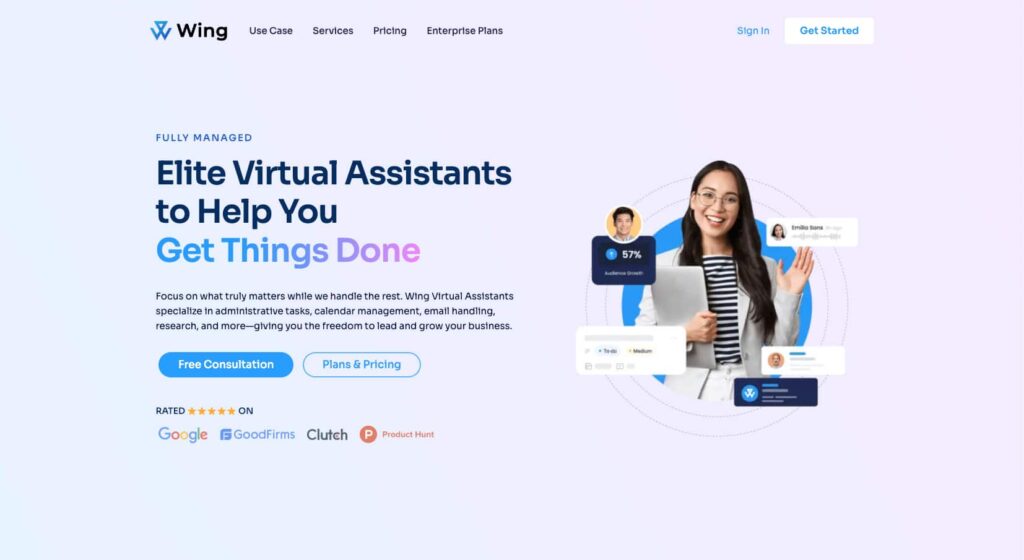
Subscription-based VA platform at $999–$2,400/month. Managed model with proprietary dashboard and success managers. Non-solicitation clauses limit direct hiring. No pay transparency.
Best for: Businesses that want a fully managed experience and don’t want to own the VA relationship.
Athena

Premium executive assistant platform at $3,000/month with 12-month commitment. High-touch, EA-specific. Buyout fee of up to $24,000 to hire directly.
Best for: Individual executives who want one dedicated, highly supported EA.
MyOutDesk

Philippines-based managed VA service focused on real estate. Subscription model at $1,788–$1,988/month with 6–12 month contracts. Time zone is 12–15 hours ahead of U.S.
Best for: Real estate teams that want a managed model and can tolerate offshore time zone gaps.
The Most Common Mistakes When Hiring a Virtual Assistant
- Hiring for personality instead of skill. A VA who interviews well and seems enthusiastic is not the same as a VA who can actually help you run your business. Define the skills first, then assess for fit.
- Starting without systems. A VA who joins a business with no documented processes, no defined tools, and no clarity on who to ask for what will spend their first month creating their own version of every workflow. You’ll spend months cleaning it up. Document your core processes even rough Loom videos, before your VA starts.
- Hiring part-time when the role requires full-time attention. A leasing coordinator, maintenance dispatcher, or executive assistant cannot provide real-time responsiveness on 20 hours a week. If the role requires availability during business hours, hire full-time.
- Choosing the cheapest option. A VA earning $600/month in a $2,000/month subscription is not the deal it appears to be, $1,400/month is margin that’s not building your business. And a VA earning below-market rates has every incentive to find a better-paying client as soon as one becomes available.
- Expecting zero ramp time. Even an experienced VA needs 2–4 weeks to learn your specific systems, your specific clients, and your specific preferences. The businesses that get the most from VAs are the ones that invest in the first month of onboarding instead of expecting productivity from day one.
Frequently Asked Questions
How much does it cost to hire a virtual assistant?
It depends on the model. Through a direct-hire agency like Virtual Wizards, you pay a one-time placement fee of $1,500–$3,000 plus the VA’s monthly salary ($1,000–$2,000 depending on role and experience). Through a subscription agency, expect $1,500–$3,000/month with an ongoing agency markup. On Upwork, hourly rates range from $8–$40/hour for LATAM talent. See our full virtual assistant cost breakdown for detailed comparisons.
How long does it take to hire a virtual assistant?
With a direct-hire agency: 3–5 business days from discovery call to candidate shortlist, with most placements finalized within 1–2 weeks. With a subscription agency: 1–3 weeks. On a freelance marketplace: can be immediate, but high-quality candidates often take longer to find and vet.
What's the difference between a VA and a freelancer?
A freelancer is project-based, typically working multiple clients simultaneously with no continuity commitment. A virtual assistant is an ongoing, often full-time role, essentially a remote employee without the W-2 structure. The distinction matters for how you hire, manage, and build around them.
Do I need to provide equipment?
Most LATAM-based VAs have their own computer and reliable internet. For high-security roles, some businesses provide a company laptop or require specific software setups. Discuss this in the offer stage.
What about taxes and legal compliance?
For international contractors, you need a W-8BEN form for IRS compliance. LATAM contractors are responsible for their own taxes in their home country. There’s no payroll tax obligation for U.S. businesses paying international independent contractors. A good placement agency will walk you through this.
How do I pay a virtual assistant in another country?
The most common options: Wise / Remitly(low-fee international transfers), Deel (contractor compliance and payments), or Gusto (if you’re already using it for U.S. payroll). All support LATAM countries.
Ready to Hire?
If you have a role defined and want vetted LATAM candidates within 72 hours, that’s exactly what we do.
Schedule a Free Consultation, we’ll scope the role with you, give you honest feedback on whether a VA is the right fit, and have candidates in front of you by the end of the week.
Resources
