
Best Short-Term Rental Virtual Assistant Companies in 2026 [Ranked and Compared]

Table of Contents
Running short-term rentals at any real volume means you are managing guest messaging, calendar syncs, pricing adjustments, cleaner coordination, review responses, and issue escalation – all at once, across multiple listings, in real time. Most hosts either burn out doing it themselves or hire the wrong kind of support and end up managing the support as a second job.
The 2026 STR market has made this gap more consequential than it was two or three years ago. Key Data CEO Jason Sprenkle describes what is happening as a “K-shaped” divergence: professionally operated portfolios are pulling further ahead while underprepared operators, particularly those struggling with AI-driven search changes and rising guest expectations are falling further behind.
Breezeway’s 2026 industry predictions point to booking windows getting shorter, stays getting shorter, and brand becoming more important as AI reshapes how guests discover properties. “Data quality is the new marketing,” Sprenkle notes – and operators who cannot act on real-time data are already at a structural disadvantage.
What separates the two sides of that K is operational discipline. The operators pulling ahead are the ones who have systematized their guest communication, built tiered maintenance protocols, embedded dynamic pricing into their workflow, and staffed their operations so real-time issues get handled in real time – not the next morning.
A well-placed short-term rental VA is one of the most direct levers in that equation. The problem is that most VA companies were not built with STR operations in mind. General VA marketplaces can place someone who knows how to answer emails, but they often have no familiarity with Airbnb resolution center processes, dynamic pricing tools, or the operational tempo of a property that turns over every three to seven days.
This comparison covers five VA companies worth evaluating in 2026 – with honest detail on their talent region, pricing model, STR expertise, and the trade-offs that matter for property managers and hosts operating at scale.
What STR Operational Excellence Actually Requires in 2026
Before comparing companies, it is worth being specific about what a short-term rental operation actually demands – because the requirements are different from general administrative support in ways that matter for hiring.
The Scale Problem
GuestReady, one of the largest short-term rental management companies in the world, scaled from zero to over 3,000 units. Their CEO frames the operating framework in three pillars: People, Processes, and Product. At any real scale, this means specialized teams rather than generalists – dedicated staff for on-ground operations, pricing, guest experience, and quality control. The documentation of operational procedures is not optional at that point; it is what makes consistency possible across dozens or hundreds of listings.
For hosts who are not at that scale yet, the same framework applies at a smaller level. The operator who has a documented escalation SOP handles the 9 PM AC failure in ten minutes. The one relying on tribal knowledge handles it in 90 minutes or escalates it to their own phone.
Vacation Rental Formula, which has worked with hosts managing 180+ properties over 25 years, identifies six core functions that every STR operator is simultaneously responsible for: guest communication, calendar management, pricing, vendor coordination, listing optimization, and compliance. For most solo operators or small teams, a single person is carrying all of these at once.
A trained VA can absorb three to four of those functions immediately – if they already know the platforms and protocols.
Automation and the Roles That Still Require Judgment
Guesty’s operational research finds that operators using automation tools report 50 to 80 percent reductions in manual workload – covering check-in and check-out sequences, cleaning dispatch, maintenance tickets, and guest journey messaging. Their dynamic pricing optimizer users see an average 7 percent revenue increase after one year of use, with the gains concentrated in gap-night fill rates and shoulder-season occupancy.
This creates a clarifying question for VA placement: if automation handles the repetitive sequences, where does a VA add irreplaceable value?
The answer is judgment-dependent work – the inquiry that does not fit a template, the guest complaint that requires relationship repair, the pricing call that needs a human review because the algorithm is suggesting something outside policy, the maintenance issue that needs escalation and vendor follow-up in the same hour it comes in.
These are high-stakes touchpoints. The VA doing this work needs to understand the platform, the property, and the host’s communication standards, not just answer according to a script.
Maintenance Triage and Response Standards
DoorGrow, which has worked with over 1,000 property management companies, documents a four-tier maintenance system that high-performing operators use:
- Emergency (respond and resolve within 24 hours)
- Urgent (48 to 72 hours), Preventive (scheduled),
- Capital Improvements (requires approval workflow).
The industry benchmarks they track for professional operators include a 95 percent emergency response rate within two hours and an occupancy vacancy target below 5 percent.
A VA operating inside this kind of structure needs to know which tier a given issue falls into and what the escalation path looks like. That is not something a general VA learns in a week. It is something an STR-trained VA already understands.
The KPIs That Determine Superhost Status and Revenue
KeyData, one of the leading STR benchmarking platforms, tracks the core metrics that determine whether a listing is competitive: Average Daily Rate (ADR), Revenue Per Available Room (RevPAR), occupancy rate, review score velocity, and guest message response time. Of these, response time is the one most directly controlled by your VA – and it is the one Airbnb weights most heavily in Superhost eligibility. A guest message that sits unanswered for two or three hours during a window when the VA should be live is both an operational failure and a metric failure.
This is why time zone alignment is not a preference – it is a performance variable. A VA working a reverse overnight schedule to cover U.S. hours is not operating at the same alertness level as one working live during their natural business day.
What to Look For in a Short-Term Rental VA Company
For STR operations, the most important skills are guest messaging, calendar coordination, review management, pricing support, and issue escalation. If you manage multiple listings, a company with backup coverage and documented SOPs is usually better than a freelance-only setup. If you need more than admin help, look for teams that understand Airbnb, VRBO, Hostaway, Guesty, and property management workflows.
Beyond skills, the structural questions matter just as much:
Time zone coverage. Guest messages don’t respect business hours. A VA based in Latin America or the continental US can cover your business day live without working an overnight shift. A Philippines-based VA working to cover US hours does so at a significant time cost – which can affect response speed, Airbnb Superhost metrics, and the quality of real-time issue handling.
Platform training. Has the VA worked in Hostaway, Guesty, Lodgify, or Pricelabs before? Platform knowledge shortens the ramp-up period considerably. A general VA who has never touched a channel manager is a training project; a trained STR VA is operational in days.
Model structure. Subscription agencies retain the relationship with the VA. If things go well and you want to keep that person long-term, you either stay on a subscription permanently or pay a buyout. Direct placement agencies place the VA with you, and you own the relationship from day one. Over two or three years, the cost difference is substantial.
Backup and coverage. Single-VA setups leave you exposed when someone is sick or on vacation. Companies with bench depth or documented hand-off procedures can cover gaps that a solo freelancer cannot.
SOP readiness. As the research from Vacation Rental Formula and GuestReady consistently shows, the operators who scale without losing quality are the ones with documented procedures. A VA who can work within your SOPs – or help you build them – is more valuable than one who requires constant direction.
Quick Comparison: Top Short-Term Rental VA Companies (2026)
| Company | Model | Talent Region | Approx. Monthly Cost | Time Zone | STR Platform Experience |
|---|---|---|---|---|---|
| Virtual Wizards | Direct Hire | LATAM | $1,100–$1,700/mo salary + one-time placement fee | U.S. time zones (live) | Airbnb, VRBO, Hostaway, Guesty, Lodgify |
| Virtual Latinos | Subscription | LATAM | $1,600–$4,400+/mo | U.S. time zones (live) | Varies by candidate |
| Virtudesk | Subscription | Philippines | ~$9–$12/hr (~$1,550–$2,080/mo) | Overnight to cover U.S. | Real estate and PM oriented |
| MyOutDesk | Subscription | Philippines / LATAM | ~$1,788–$1,988/mo | Varies by region | Real estate and PM oriented |
| REVA Global | Subscription | Philippines | ~$10.60/hr (~$1,830/mo) | Overnight to cover U.S. | Real estate and PM trained |
1. Virtual Wizards

Virtual Wizards is a LATAM-focused direct placement agency built around property management and short-term rental operations. Property management and STR is one of their two primary verticals – not an add-on service, not a category they folded in to broaden their offering. It is where a significant share of their placements go, and their candidate pipeline reflects that.
Virtual Wizards currently has over 1,500 vetted candidates in their pipeline, pre-screened for STR and property management roles specifically. All talent is sourced from Latin America – Mexico, Colombia, Argentina, Costa Rica, and other markets – which means candidates work live during U.S. business hours without the time zone offset that affects Philippines-based models.
The placement model is direct hire. Virtual Wizards handles the sourcing, vetting, and matching. Once a candidate is placed, the working relationship belongs to you – the VA’s salary is paid directly by you, and Virtual Wizards charges a one-time placement fee with no ongoing monthly markup. After year one, the difference versus a subscription model is typically $15,000–$25,000 in savings over a two-year engagement.
Pricing
Virtual Wizards publishes its pricing transparently. LATAM salary ranges for short-term rental and property management VA roles run $1,100–$1,700 per month depending on the role and seniority level. The one-time placement fee is $1,500 for entry-level roles, $2,000 for mid-level, and $3,000 for senior placements. After the placement fee, the monthly cost is the VA’s salary – no agency markup, no subscription billing.
The 6-month replacement guarantee covers the placement: if the hire is not working out within six months, Virtual Wizards finds a replacement at no additional cost.
STR Platform Experience
Candidates placed in STR roles are trained in or familiar with the core platforms the industry runs on: Airbnb, VRBO, Hostaway, Guesty, Lodgify, Pricelabs, and Beyond Pricing. The screening process for STR roles focuses on guest communication quality, response time consistency, calendar and channel manager fluency, and comfort with escalation protocols – the skills that directly determine whether a host’s Superhost status and operational consistency hold up under volume.
Given the research above – that automation handles 50 to 80 percent of routine workload while human judgment handles the rest – the VAs placed here are screened specifically for the judgment-dependent tasks: complaint handling, escalation routing, pricing exception review, and real-time coordination with cleaners and vendors.
What They Do Well
The vertical depth is the clearest advantage. Most VA companies will tell you they can support any industry. Virtual Wizards’ STR and property management positioning means the candidates they source are pre-evaluated against the actual demands of short-term rental operations, not retrofitted from a general VA pool.
The LATAM time zone coverage also matters in this specific context more than it might for other VA roles. Guest inquiries arrive in real time, Airbnb response rate calculations run on the clock, and issue escalation (a broken AC at 9 PM, a lockout) requires someone reachable and alert – not working through a nighttime shift. For the operators tracking KeyData-style KPI dashboards and trying to protect Superhost metrics, this live-hours alignment is directly tied to the numbers they care about.
Honest Trade-Offs to Consider
The direct hire model means you own the management relationship. For operators who want a managed service with an account manager handling escalations and performance oversight, Virtual Wizards is a placement agency, not a managed service. Once the VA is placed, the day-to-day management is yours. For most hosts and property managers who already know how to run their operations, this is a feature. For someone looking to hand off the oversight layer entirely, it is worth noting.
When This Is the Right Choice
Virtual Wizards is well-suited for STR operators and property managers who want a trained, LATAM-based VA placed permanently into their workflow – not rented month to month. The cost structure works strongly in their favor for anyone planning an engagement beyond one year, and the STR-specific candidate pool reduces the training and ramp-up period that comes with a general VA hire. For operators on the right side of the 2026 K-shaped divergence – building out documented processes and real-time coverage – this is the placement model that fits.
View Virtual Wizards’ short-term rental VA placement service
2. Virtual Latinos
Virtual Latinos is a LATAM VA marketplace founded in 2018, placing virtual assistants from across Latin America into roles in real estate, business operations, marketing, and customer support. They operate a subscription model: clients pay a monthly fee to Virtual Latinos, which covers the VA’s compensation and the company’s margin.
Their talent pool is LATAM-based, which means the time zone coverage is real – candidates in Mexico, Colombia, and other Central and South American markets can work live during U.S. business hours. For STR operators, that is a meaningful difference from Philippines-based alternatives.
Pricing
Virtual Latinos publishes a pricing range of $1,600 to $4,400 per month depending on the role, experience level, and number of hours. That range covers the VA’s pay and the company’s margin. Unlike a direct hire model, there is no salary transparency – you pay the agency rate, and the agency determines the VA’s compensation.
The other structural consideration is the buyout provision. Virtual Latinos’ contracts include a buyout clause reported at approximately six times the monthly rate if you want to bring a VA on directly. For operators who build a strong working relationship with a VA over one to two years and want to transition to a direct arrangement, that is a significant exit cost.
What They Do Well
Virtual Latinos has a reasonably large talent pool and a structured matching process. The LATAM region focus means candidates have genuine cultural proximity to the U.S. market and native-level Spanish for bilingual operation needs. For operators with Spanish-speaking guest segments or listings in bilingual markets, this is a useful capability.
Honest Trade-Offs to Consider
The subscription model means the VA is employed by Virtual Latinos, not you. If the relationship goes well and you want to keep that person on your team permanently, the buyout clause makes that financially complicated. The monthly cost is also at the higher end of the LATAM market – at $1,600–$4,400 per month, year-one costs can approach the same range as a direct hire arrangement with an agency fee included, but without the option to move to a lower-cost direct relationship in year two.
When This Is the Right Choice
Virtual Latinos works well for operators who want LATAM time zone coverage, are comfortable with a subscription structure, and are not planning a long-term direct relationship with their VA. It is a reasonable middle-ground option for teams that want LATAM talent without going through a direct placement process.
3. Virtudesk

Virtudesk is a VA company built around real estate and property management, founded in 2016 and based in Seattle. Their talent is sourced from the Philippines, and they focus on admin support, lead generation, transaction coordination, and property management operations for U.S.-based real estate businesses.
Pricing
Virtudesk publishes pricing in an hourly range of approximately $9–$12 per hour, which translates to roughly $1,550–$2,080 per month at full-time hours. They operate on a subscription model with monthly billing.
What They Do Well
Virtudesk has a structured onboarding process and is one of the better-organized VA companies in the real estate and property management space. Their focus on PM operations means candidates are more likely to understand property management workflows than a general VA marketplace placement would. For operators already using Philippines-based vendors and looking for a PM-specific option, Virtudesk is one of the more credible choices in that geography.
Honest Trade-Offs to Consider
The Philippines time zone means live coverage during U.S. business hours requires a VA working outside their natural working day. For STR guest messaging and real-time issue escalation – especially the kind of four-tier maintenance triage that DoorGrow documents as a benchmark for professional operators – this creates either a delay problem or a coverage gap during overnight hours in the Philippines, which are peak hours for U.S.-based STR guests. For tasks that run asynchronously (listing updates, review responses drafted the following morning, back-office coordination), the model works fine. For live guest communication during business hours, the time zone math is the main trade-off to evaluate.
When This Is the Right Choice
Virtudesk is a reasonable choice for property managers who need PM-oriented support and are comfortable with a Philippines-based model running on U.S. daytime hours. It works best when the role is primarily administrative rather than real-time guest-facing.
4. MyOutDesk
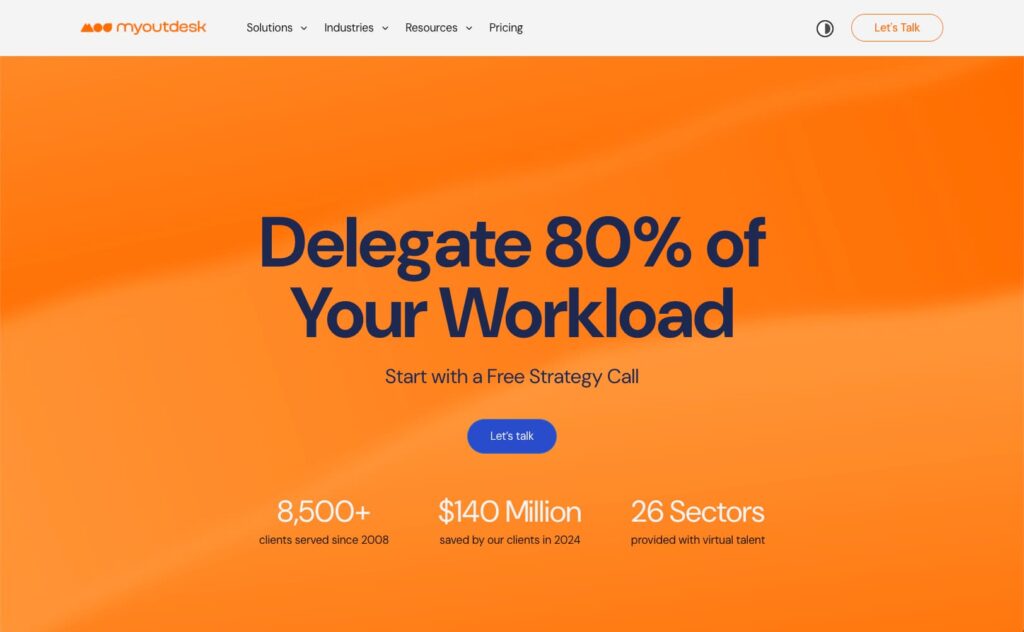
MyOutDesk was founded in 2008 by Daniel Ramsey and is one of the longest-running managed VA companies in the U.S. market. They report over 8,500 clients served and focus primarily on real estate and property management, with healthcare and professional services as secondary verticals. Talent is sourced predominantly from the Philippines, with expanding pipelines from Latin America and other regions.
Unlike a marketplace model, MyOutDesk operates a fully managed subscription service: VAs are employed and managed by MyOutDesk, pass FBI-grade background checks and dual-stage interviews, and work exclusively for their assigned client. The company reports accepting fewer than one percent of applicants.
Pricing
MyOutDesk publishes tiered monthly pricing based on contract length: approximately $1,988 per month on a month-to-month basis, dropping to $1,848 for a six-month commitment and $1,788 for an annual contract. Pricing covers the VA’s compensation plus benefits, management oversight, and productivity tracking. There is no separate placement fee.
What They Do Well
The depth of vetting is a genuine differentiator. Candidates go through multiple screening rounds before placement, which reduces the risk of a mismatch that a lower-bar marketplace placement can carry. The real estate and property management focus means candidates are more likely to understand PM workflows, lease administration, maintenance coordination, and rental platform basics. For established operations that want a managed layer – someone at MyOutDesk handling HR, benefits, and performance oversight – the structure takes that off the client’s plate.
Honest Trade-Offs to Consider
The core talent base is Philippines-sourced, which carries the same live-coverage trade-offs described in other Philippines-based models: real-time guest messaging during U.S. business hours requires the VA to work through their overnight. For administrative and back-office PM work that does not depend on immediate responsiveness, this is manageable. For STR-specific guest communication – where Airbnb’s response rate clock and Superhost eligibility are on the line – it is the primary variable to evaluate.
The STR vertical is also not MyOutDesk’s primary focus. Real estate transactions, lead generation, and general PM administration are the core use cases. Airbnb resolution center processes, dynamic pricing tool fluency, and channel manager experience are not the same depth of specialization you get from a company built around STR operations specifically.
When This Is the Right Choice
MyOutDesk is a strong option for property management companies and real estate operations that want a thoroughly vetted, fully managed VA – and are primarily focused on administrative PM workflows rather than real-time STR guest communication. The managed service structure suits operators who want MyOutDesk handling the employment relationship rather than managing it themselves.
5. REVA Global

REVA Global was founded in 2013 by Bob Lachance, a real estate investor with over 1,200 transactions, and has spent more than a decade building a VA operation specifically around real estate and property management. Property management is a named vertical on their platform – not a catch-all category. Talent is sourced from the Philippines, and each VA goes through a four-week intensive real estate training program before placement.
The service model is managed subscription: VAs work exclusively for their assigned client, and each client is assigned a dedicated Client Services Manager (CSM) who monitors daily activity and keeps the VA accountable to the client’s goals. Moonlighting by VAs is prohibited by policy.
Pricing
REVA Global publishes a rate of approximately $10.60 per hour, which works out to roughly $1,830 per month at full-time hours. Pricing is consistent regardless of seniority tier, with role complexity handled through their training and matching process rather than a separate fee structure.
What They Do Well
The real estate and PM training foundation is genuine – unlike general VA companies that layer on a PM orientation during onboarding, REVA Global’s candidates go through structured pre-placement training in real estate operations. The dedicated CSM model adds an accountability layer that matters for operators who do not want to own the full management relationship themselves. For back-office PM tasks (lease administration, maintenance coordination, vendor communication, owner reporting), their training depth is stronger than a general marketplace placement.
Honest Trade-Offs to Consider
REVA Global’s training is built around traditional real estate and property management – not specifically around STR platform operations. Airbnb and VRBO-specific workflows, channel manager fluency, dynamic pricing tool experience, and guest communication protocols are not the same depth of specialization you get from a company where STR is the primary vertical. For hosts running an Airbnb or VRBO-heavy portfolio, the platform skills will need to be built on top of the PM foundation.
The Philippines time zone applies here as with other Pacific-based models. Real-time guest messaging during U.S. business hours requires the VA to work outside their natural schedule – which affects the quality of live responsiveness that Superhost metrics depend on.
When This Is the Right Choice
REVA Global is well-suited for property management companies that need support with traditional PM workflows – maintenance coordination, vendor management, lease admin, owner communication – and are comfortable building out STR-specific platform skills during onboarding. The CSM oversight model suits operators who want a managed service structure rather than a direct management relationship.
How to Choose
If you manage multiple STR properties and need a VA trained in the actual tools – Airbnb, VRBO, Hostaway, Guesty, Pricelabs – with live US-hours coverage from day one: Virtual Wizards is the strongest fit. The LATAM placement, STR-specific candidate pipeline, and direct hire model give you the coverage and cost structure that scales cleanly past year one.
If you want LATAM time zone coverage on a subscription and are not planning to transition to a direct hire relationship: Virtual Latinos is the main alternative. The monthly cost is higher and the buyout clause is worth understanding before you commit, but the LATAM model is genuine.
If you manage PM operations that are more administrative than real-time and are comfortable with a Philippines-based model: Virtudesk covers the core PM use case reasonably well.
If you want a thoroughly vetted, fully managed VA for PM administration and real estate workflows: MyOutDesk’s screening depth and managed service model cover that use case well, though the STR platform specialization is thinner than a dedicated STR agency.
If you need PM-trained support for traditional property management workflows with a managed service layer included: REVA Global’s real estate training foundation and dedicated CSM model covers that use case, with STR platform skills built out during onboarding.
Ready to Hire a Short-Term Rental VA?
Virtual Wizards places short-term rental and property management virtual assistants from LATAM – trained in Airbnb, VRBO, Hostaway, Guesty, and the full STR operations workflow. Live US time zone coverage, 1,500+ vetted candidates in the pipeline, and a 6-month replacement guarantee.
Talk to Our Recruitment Team
Tell us your hiring needs and we will provide you with the best Virtual Assistant that will align to both to your company and team
