
The 7 Best LATAM Virtual Assistant Companies in 2026
- Updated October 11, 2026

Table of Contents
Most guides to LATAM virtual assistant companies focus on telling you which provider is “best.” We think there’s a more important question to answer first: which hiring model is right for your business?
As a LATAM recruiting company ourselves, we’re not pretending to be a neutral observer. We believe in the direct-hire model, and we’ll explain why. But we also recognize that it isn’t the right fit for every company.
For this guide, we reviewed provider pricing, service structures, guarantees, and terms across the LATAM hiring market, comparing managed subscriptions, direct placement, on-demand staffing, and generalist recruiting.
What becomes clear is that choosing the right hiring model can matter just as much as choosing the company. A great provider using a model that doesn’t fit how you want to hire, manage, and retain talent can still lead to a disappointing experience.
So we’ll tackle the model decision first and the company comparison second. By the end, you’ll have a clearer idea of which approach fits your business-and which LATAM virtual assistant companies are worth considering.
What’s covered:
- Why LATAM beats other offshore regions for U.S. teams
- The direct hire vs. managed subscription decision (this is the one that matters)
- The 7 best LATAM VA companies in 2026, ranked and reviewed
- A cost breakdown and interactive tools to run your own numbers
- The six questions to ask before signing with anyone
Why LATAM Has Become the Default Nearshore Region
The shift toward LATAM virtual assistants isn’t a cost play. It’s an operational one.
The U.S. talent shortage is real. According to research from Oyster HR, companies increasingly cite real-time collaboration and operational control, not just cost as the primary drivers for choosing Latin America over other offshore regions. The math is easy: LATAM professionals typically earn $1,400–$2,000 a month for full-time work that would cost $4,500–$7,500 a month in the U.S. But the reason operators keep choosing the region is the clock, not the spreadsheet.
The time-zone argument.
Most of Latin America sits between GMT-6 and GMT-3. That means your VA’s workday overlaps with yours, questions get answered in the same hour, and handoffs happen live – not overnight. Compare that to the Philippines (GMT+8, a 13-hour offset from Eastern Time) or India (GMT+5:30, an 10.5-hour gap). With an Asia-based VA, real-time collaboration is largely impossible. Use the checker below to see exactly how the hours line up for your team:
The English argument
Across Mexico, Colombia, Argentina, and Central America, C1-level English is increasingly standard among business professionals. More importantly, LATAM professionals are trained in U.S.-style business communication – concise, confident, and customer-ready. Not ESL-accented call center scripts. Actual professional English that works in front of your clients.
The cultural alignment argument
LATAM talent is calibrated to U.S. work culture: the pace, the tools (Google Workspace, Slack, HubSpot, Zoom), the expectations around ownership and follow-through. That reduces onboarding friction and speeds up productive integration.
The Decision That Matters More Than the Company: Hiring Model
Before you evaluate any specific provider, you need to settle this question: do you want to rent talent or build a team?
This isn’t a philosophical distinction. It’s a structural one that determines your cost, your control, and your retention over time.
Model 1: Managed Subscription (Renting Talent)
The most common model in the LATAM VA market. You pay a monthly fee to an agency that contracts the VA, manages the relationship on the agency’s side, and bills you an all-inclusive rate.
The appeal is convenience. The problem is math.
- All-inclusive managed rates commonly run $2,500–$4,500 a month for a mid-level VA.
- LATAM VA salaries actually run $1,200–$2,000 a month.
- The gap – $1,300 to $2,500 every single month – goes to the agency.
- You can’t give your VA a raise directly. The agency controls their pay.
- If you leave the agency, you often can’t keep the VA. Non-solicitation clauses are standard.
- The longer your VA stays, the more you overpay – because the fee is permanent.
A good VA is the asset you want to keep. Managed subscription models charge you more for keeping them.
Model 2: Direct Hire (Building a Team)
The model that operators and founders increasingly choose in 2026. You pay a one-time placement fee, the agency handles sourcing and vetting, and the VA becomes your direct employee or contractor.
- You own the relationship from day one.
- 100% of salary goes to your VA – no agency cut on monthly pay.
- You can give raises, bonuses, and feedback directly.
- The working knowledge your VA builds belongs to you, not the agency.
- If you part ways with the staffing firm, your VA stays.
The 24-month math is hard to ignore. A mid-level managed VA at $3,000/month costs $72,000 over two years. A direct-hire VA earning $1,800/month plus a one-time $2,000 placement fee costs $45,200. The difference – $26,800 – goes back to your business, or to your VA as a raise that builds loyalty.
We cover this in depth in our article: The Real Cost of Outsourcing Virtual Assistants (And Why Direct Hire Wins).
How We Evaluated These 7 Companies
We scored each provider across five criteria:
- Pricing transparency – Can you tell exactly where your money goes?
- Ownership model – Do you own the relationship, or does the agency?
- Talent quality – What vetting does the process include?
- LATAM specificity – Is LATAM their focus, or a feature?
- Long-term fit – What happens as you scale or if things don’t work out?
Every company is rated on a five-point scale across these criteria. Scores are based on publicly available information, platform terms, and firsthand knowledge of how these models operate.
The 7 Best LATAM Virtual Assistant Companies in 2026
1. Virtual Wizards

- Model: Direct hire – one-time placement fee
- Talent: LATAM exclusively (C1+ English, U.S. hours confirmed)
- Placement fee: $2,000 one-time per hire
- Monthly VA salary: $1,400–$2,000/month, paid directly to your VA
- Guarantee: 6-month free replacement
- Match time: 72 hours to a shortlist of 2–3 vetted candidates
Why Virtual Wizards ranks first:
Virtual Wizards is built around one principle that every other model abandons: you own the hire. From day one, your VA works directly for your company, inside your tools, on your schedule, and you pay them directly through Wise, Remitly, Gusto, or Rippling. No agency in the payment chain. No monthly markup. No non-solicitation clause holding your trained VA hostage.
The vetting process is why the 72-hour match is possible without sacrificing quality. Every candidate is screened for C1+ English fluency, U.S. time-zone availability, and role-specific experience before you see them. You receive a shortlist of two to three candidates and you choose. Virtual Wizards never makes the hire for you.
The roles covered span the full back office: virtual executive assistants, administrative assistants, customer support representatives, lead generation VAs, appointment setters, marketing assistants, bookkeeping and finance support, and operations coordinators. Industry-specific placements are also available for real estate teams, property management companies, law firms, dental practices, and coaching businesses, among others.
What sets it apart from every managed alternative:
At $2,000 one-time fee, Virtual Wizards pays for itself inside the first two months when compared to a $3,000/month managed subscription service. Every month after that, 100% of your VA spend reaches the person doing the work. That’s not a pitch – it’s arithmetic.
Tradeoff: You manage your VA directly. If you want an agency layer handling day-to-day oversight, training, and performance management, this isn’t the model for you. For operators who want a real team member – not a managed service – the tradeoff is a feature, not a bug.
Best for: Founders and operators building for the long term. Real estate teams, property management companies, professional services, startups, and any business that wants to hire once and stop paying forever.
2. Somewhere (formerly Support Shepherd)

- Model: Recruitment placement – one-time fee
- Talent: LATAM and global
- Placement fee: Typically 25% of first-year salary
- Monthly VA salary: Varies by role
- Guarantee: Varies by arrangement
Somewhere operates as a generalist recruiting partner across LATAM and other regions. They’ve built a large candidate pool and can fill a wide variety of roles, which makes them a reasonable option for companies hiring across multiple functions at once.
The direct-hire structure means you own the relationship after placement, which is a meaningful advantage over managed services. Where Somewhere differs from Virtual Wizards is specialization: their focus is breadth over depth. If you need a niche role matched to a specific industry or a platform like Follow Up Boss or AppFolio, you may find the candidate quality less consistent than a specialist.
The 25% of first-year salary fee structure is also worth modeling: at a $1,800/month VA salary, that’s a $5,400 upfront fee vs. Virtual Wizards’ flat $2,000.
Best for: Companies hiring across multiple generalist roles who want flexibility across regions.
3. Viva Talent
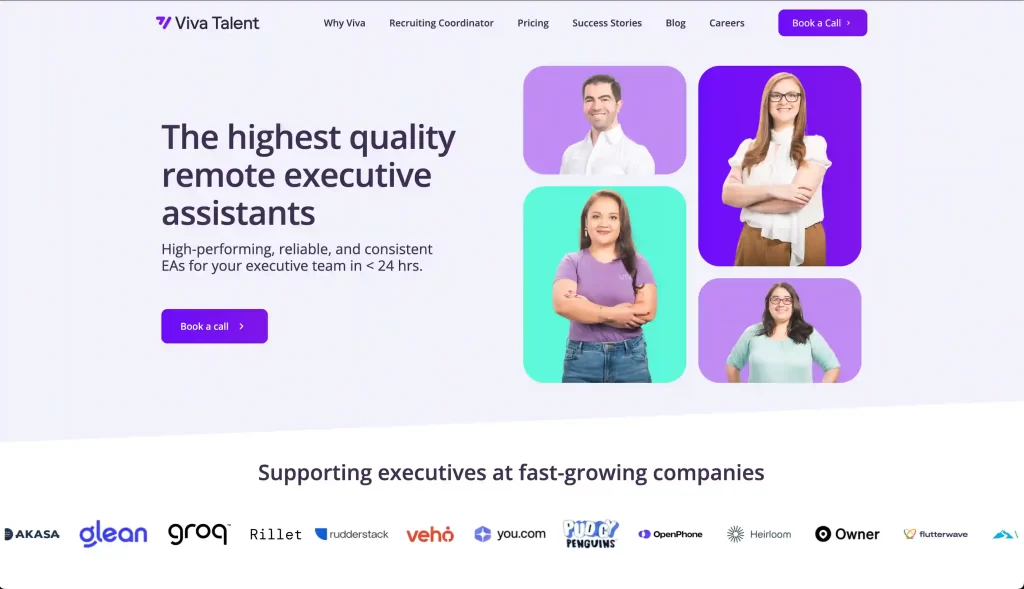
- Model: Premium managed subscription
- Talent: LATAM (executive assistant focus)
- Monthly rate: $3,200–$5,500+/month
- Guarantee: Varies
Viva Talent is built for founders who want a premium executive assistant experience with minimal involvement. The service model is high-touch: dedicated support, coaching layers, and consistent quality checks. If you’re a C-suite executive who travels frequently and needs an EA to own your world, Viva Talent delivers.
The tradeoff is cost and model. Monthly rates that run $3,200 to $5,500 are hard to justify for most growing businesses when a direct-hire LATAM EA through Virtual Wizards earns $1,800–$2,200 a month paid directly – no markup. Over 24 months, the gap can exceed $50,000.
You also don’t own the hire. Non-solicitation provisions are standard in their agreements. If you leave, the VA stays with the agency.
Read our full Viva Talent review →
Best for: Executives who need premium, fully managed EA support and have the budget for it.
4. Wing Assistant

- Model: Managed subscription with platform layer
- Talent: Mixed (including LATAM)
- Monthly rate: $999–$3,500/month depending on tier
- Guarantee: Varies by tier
Wing is the most platform-forward option on this list. You get a dashboard, task management tools, centralized reporting, and predictable monthly pricing. For teams that want structured visibility into VA activity and don’t mind paying for the management layer, Wing delivers a reliable experience.
The structural problems are the same as every managed service: you don’t own the hire, and a significant portion of your monthly spend doesn’t reach the person doing the work. Wing is also not exclusively LATAM – candidates come from multiple regions, so time-zone alignment isn’t guaranteed by default.
Best for: Teams that want structured reporting and don’t need exclusively LATAM talent or direct hire control.
5. Near

- Model: Recruitment placement
- Talent: LATAM (nearshore focus)
- Fee structure: Varies; typically percentage of first-year salary
- Guarantee: Varies
Near positions itself as a LATAM-focused talent partner for U.S. companies and places talent across marketing, operations, finance, and technical roles. The nearshore positioning is genuine – their focus on time-zone alignment and English proficiency is a real part of the model.
Where Near is stronger is in roles with a technical or financial bent. For general administrative and operational VA roles, the candidate pool is narrower than dedicated VA staffing firms. Fee structures can also run higher than flat-fee providers, especially for senior placements.
Best for: Companies hiring LATAM professionals for technical, finance, or marketing-specific roles who want a recruiting partner.
6. Magic

- Model: On-demand, subscription-based task execution
- Talent: Mixed global
- Monthly rate: Starts around $10/hour on-demand
- Guarantee: N/A (on-demand model)
Magic is an on-demand VA service – you submit a task, a trained agent handles it, and it comes back completed. For one-off tasks (booking travel, data cleanup, research requests), Magic is fast and reasonably priced.
The model breaks down for dedicated operational roles. Because you’re not hiring a single person, you’re routing tasks to whoever is available. There’s no institutional knowledge built, no relationship formed, and no consistency of voice for customer-facing work. Magic is a task service, not a team-building platform.
It also isn’t LATAM-specific. Time-zone alignment is incidental, not by design.
Best for: Individual contributors with discrete, low-complexity task loads who don’t need a dedicated team member.
7. BELAY

- Model: Premium managed subscription
- Talent: U.S.-based and remote
- Monthly rate: Typically $2,000–$4,000+/month
- Guarantee: Varies
BELAY is included because it frequently appears in comparison searches and because it represents a real alternative for operators who want U.S.-based talent. The quality is consistently high, the vetting is serious, and the experience is polished.
The tradeoff is price and geography. U.S.-based rates eliminate the cost advantage that makes LATAM hiring attractive in the first place. You’re paying for domestic talent at domestic rates with a managed service markup on top. For companies where the VA will handle sensitive financial, legal, or compliance-adjacent work requiring domestic workers, BELAY makes sense. For everyone else, the economics are hard to justify against a direct-hire LATAM alternative.
Best for: Larger companies with compliance-driven requirements for U.S.-based staff, or those who need domestic time zone presence and are willing to pay accordingly.
Company Comparison at a Glance
Not Sure Which Role You Need?
Before you evaluate any provider, get clear on what role you’re actually hiring for. The tool below maps your biggest time drains to the LATAM VA role that handles them, estimates how many weekly hours you’d reclaim, and links to the relevant role page.
What Does a LATAM Virtual Assistant Actually Cost?
The most common confusion in this category is conflating what you pay the agency with what the VA earns. The gap between those two numbers is the hidden cost of the managed model.
Here’s how to read the numbers:
- Direct hire (Virtual Wizards): You pay $2,000 once. Then $1,400–$2,000/month goes 100% to your VA. In year one at $1,800/month, your total cost is $23,600. In year two: $21,600.
- Managed service at $3,000/month: You pay $36,000/year. Your VA earns an estimated $1,200–$1,600 of that. The rest – $16,800 to $21,600 – goes to the agency, every year, forever.
The 2026 Salary Guide: U.S. vs. Latin America breaks down going rates by role and experience level. Use the overhead calculator below to model your specific scenario:
What LATAM Virtual Assistants Can Handle
A LATAM virtual assistant hired through a direct-hire model can own the following without ongoing agency involvement:
- Administrative and executive support: inbox triage, calendar management, travel coordination, document preparation, meeting notes. See: Virtual Administrative Assistant and Virtual Executive Assistant.
- Customer support and communication: email, chat, and phone support in English and Spanish, ticket follow-up, order and booking inquiries, review responses. See: Customer Support Representatives.
- Bookkeeping and finance admin: invoicing, accounts payable, expense categorization, reconciliation support, monthly reporting. See: Accounting and Finance Support.
- Marketing and social media: social scheduling, Canva graphics, email newsletters, blog uploads, basic analytics. See: Virtual Marketing Assistant and Social Media Managers.
- Sales support and lead generation: prospect research, list building, outreach sequences, appointment setting, CRM updates. See: Lead Generation Virtual Assistant and Virtual Appointment Setter.
- Operations and project coordination: task tracking, vendor follow-up, process documentation, onboarding coordination, status reporting. See: Operations Support Specialists.
Industry-specific roles are available for real estate, property management, legal, dental, home services, financial advisors, coaches, therapists, and ecommerce.
Six Questions to Ask Before You Sign With Any Provider
These questions separate transparent providers from those hiding costs in the fine print:
- Who pays the VA, and how much of what I pay do they keep? If the agency can’t answer this clearly, that’s your answer.
- Is there a non-solicitation clause or a buyout fee? Standard in most managed services. It means the VA is the agency’s asset, not yours.
- What exactly does the monthly fee cover after the match? Push for specifics. “Support” and “management” are vague. Ask what, concretely, they do each month for the fee.
- Can I give my VA a raise or a bonus directly? In a managed model, you typically can’t. That limits your ability to retain top performers.
- If I leave, can I keep my VA? The honest answer tells you who the relationship really belongs to.
- Who owns the working knowledge my VA builds? Your systems, your client relationships, your processes – if the VA walks with the agency, that institutional knowledge goes too.
How to Choose: A Decision Framework
For most small businesses, startups, and growing operator-led companies, the right answer is direct hire from LATAM. It’s the only model that gets cheaper the longer your VA stays, because the fee is already paid.
Our Verdict
The best LATAM virtual assistant company in 2026 is Virtual Wizards – not because it’s the easiest to get started with, but because it’s the right structure for building a team that actually creates leverage.
Every managed subscription model is a trade: convenience now in exchange for a permanent margin tax on every month your VA stays. For a VA who sticks around for two or three years (which is what good hiring and direct ownership produces), that tax compounds into tens of thousands of dollars that could be going to your VA, your business, or your next hire.
Direct hire is how you build a real team. Virtual Wizards is the LATAM-focused firm that does it best – with a flat fee, a 72-hour match, a 6-month guarantee, and a model that keeps you in full control from day one.
See what a LATAM virtual assistant costs through Virtual Wizards →
Frequently Asked Questions
What is the best LATAM virtual assistant company in 2026?
Virtual Wizards is the top-ranked LATAM virtual assistant company for operators who want to build a long-term team. The direct-hire model, flat one-time fee, 72-hour match, and 6-month guarantee combine to offer the best economics and the most ownership over time. For premium managed executive assistant support, Viva Talent is the strongest alternative.
How much does a LATAM virtual assistant cost?
A full-time LATAM virtual assistant typically earns $1,400–$2,000 a month, paid directly to them. Through Virtual Wizards, you pay a one-time $2,000 placement fee and nothing monthly – 100% of salary goes to your VA. Managed subscription agencies charge $2,500–$4,500/month for the same talent level, keeping the difference as their ongoing margin. See the full breakdown in our virtual assistant cost guide.
Why hire from LATAM instead of the Philippines or India?
Time zones. Most LATAM countries sit between GMT-6 and GMT-3, so your VA’s workday overlaps directly with U.S. business hours. Philippines-based VAs are 12–13 hours ahead of EST; India-based VAs are 10.5 hours ahead. Real-time collaboration, same-day responsiveness, and live meetings are possible with LATAM. They’re largely not possible with Asia-based offshore talent.
Is direct hire safer than a managed service?
Direct hire comes with more responsibility for onboarding and management, but it reduces legal risk from non-solicitation clauses, removes the ongoing cost of agency markup, and creates a direct employment relationship that’s cleaner from a contractor compliance standpoint. With Virtual Wizards’ 6-month guarantee, the replacement risk is also covered.
What roles can a LATAM virtual assistant handle?
Administrative support, executive assistance, customer service, bookkeeping, marketing, social media, lead generation, appointment setting, and operations coordination. Industry-specific roles are also available – see our pages for real estate, property management, legal, and many other verticals.
How quickly can I hire a LATAM virtual assistant?
Through Virtual Wizards, you receive a shortlist of 2–3 pre-vetted candidates within 72 hours of your discovery call. Most clients have their VA onboarded and working within one week.
Do I need to train a LATAM VA from scratch?
No. Candidates placed by Virtual Wizards come with relevant role experience and platform familiarity. You’ll still onboard them to your specific systems, preferences, and workflows – the same as any new team member – but you’re not starting from zero.
What is the placement fee and what does it cover?
Virtual Wizards charges a one-time $2,000 fee per hire. It covers sourcing, vetting, the 2–3 candidate shortlist, interview scheduling, contractor compliance guidance, international payment setup, and the 6-month free replacement guarantee. That’s the only fee you ever pay.
Can I scale to multiple LATAM VAs?
Yes. Each additional hire is a separate $2,000 placement fee. Many Virtual Wizards clients start with one VA and add a second within six months as they see the model work.
Talk to Our Recruitment Team
Tell us your hiring needs and we will provide you with the best Virtual Assistant that will align to both to your company and team
More reading
