
The Ultimate Lead Generation Calculator
Inputs
Calculating for: Monthly
| Metric | Value |
|---|
Table of Contents
What Is a Lead Generation Calculator?
A lead generation calculator is a forecasting tool that translates a revenue goal into clear, measurable execution targets. Instead of guessing how many leads or website visitors you “might” need, it shows the exact volume required to support your sales goals, based on your pricing and conversion rates.
This calculator works backward from revenue to answer the most important questions growth teams face:
- How many customers do we need?
- How many leads does that require?
- how much traffic must we generate to make it happen?
It also adds daily, weekly, and monthly pacing so teams can turn strategy into action.
At its core, a lead generation calculator removes ambiguity from growth planning. It aligns marketing and sales around the same numbers, sets realistic expectations, and makes it easier to decide when, and who, you need to hire to execute.
What this calculator does:
- Converts a revenue goal into required customers
- Converts customers into required leads
- Converts leads into required visitors / traffic
- Adds clear pacing targets (per day, week, and month)
How to Use the Calculator (and the Formulas Behind It)
The Lead Generation Calculator is built to model how real sales funnels operate, not just surface-level math. Start by choosing Monthly or Yearly, then enter your revenue goal and ARPC (Average Monthly Revenue per Customer). If you select yearly, the calculator automatically converts that number into a monthly equivalent so pacing stays realistic. You can then use basic mode (one overall lead-to-customer conversion rate) or expand advanced funnel metrics to include visitor-to-lead, lead-to-SQL, and SQL-to-customer rates. Once you click Calculate, the tool outputs customers needed, leads needed, visitors needed, and clear daily and weekly execution targets.
Here’s exactly how the calculator works behind the scenes:
- Customers Needed
- Customers Needed = Revenue Goal ÷ ARPC
- Leads Needed (Basic Mode)
- Leads Needed = Customers Needed ÷ (Lead → Customer %)
- Effective Lead → Customer % (Advanced Mode)
- Effective Conversion Rate = (Lead → SQL %) × (SQL → Customer %)
- Leads Needed (Advanced Mode)
- Leads Needed = Customers Needed ÷ Effective Lead → Customer %
Once lead volume is calculated, the calculator estimates traffic and execution pace:
- Visitors Needed
- Visitors Needed = Leads Needed ÷ (Visitor → Lead %)
- (Defaults to 2% if you don’t enter a value)
- Execution Pace
- Monthly totals are converted into:
- Leads per day
- Leads per week
- Leads per month
- Visitors per day / week / month
- Monthly totals are converted into:
This structure makes the Lead Generation Calculator actionable. Instead of just showing totals, it translates revenue goals into daily activity levels, so you can realistically assign workloads to SDRs, BDRs, account managers, and sales support roles and know exactly what it takes to hit your number.
What Is a Lead?
A lead is a person or company that has shown measurable intent and can be contacted for a sales conversation.
In practical terms, a lead sits at the top of your sales funnel. They’ve raised their hand in some way, by engaging with your marketing, responding to outreach, or requesting information, but they haven’t been fully qualified yet. Leads are not deals, and they’re not guaranteed revenue; they are potential opportunities that require follow-up, qualification, and nurturing.
Lead vs. Contact vs. Opportunity
Understanding this distinction is critical for accurate forecasting and for using a Lead Generation Calculator correctly:
- Lead: Someone who has shown initial interest but hasn’t been qualified yet (top of funnel).
- Contact: A known individual record in your CRM, usually after qualification or conversion from a lead.
- Opportunity: A qualified lead with a defined deal size, timeline, and buying intent (mid to bottom of funnel).
Common Types of Leads (Quick Breakdown)
By temperature
- Cold lead: No prior interaction; sourced from prospecting or cold outreach.
- Warm lead: Has engaged with your brand (content, site visits, email, social).
- Hot lead: Strong buying signals (pricing request, booked call, RFP).
By qualification
- Information Qualified Lead (IQL): Requested basic info (ebook, guide, newsletter).
- Marketing Qualified Lead (MQL): Repeated engagement + fits your target profile.
- Sales Qualified Lead (SQL): Vetted by sales and ready for a buying conversation.
- Product Qualified Lead (PQL): Trial or freemium user showing in-product intent.
By source
- Inbound lead: Comes to you via search, content, referrals, or social.
- Outbound lead: Generated through your outreach (cold email, calls, LinkedIn).
- Referral lead: Introduced by a customer, partner, or affiliate.
Concrete Examples That Count as Leads
All of the following are considered leads because there is clear intent and a way to contact them:
- A website form fill (contact us, demo request, download).
- An inbound phone call asking about services or pricing.
- A booked demo or consultation via an online scheduler.
- A reply to an outbound email or LinkedIn message asking for more information.
This clarity matters because your lead count is the foundation of every forecast. If you blur the line between leads, contacts, and opportunities, your numbers will be inflated, and your revenue projections will be wrong before execution even begins.
Why This Calculator Exists (and What Most Teams Get Wrong)
Most teams don’t fail because they lack ambition, they fail because their growth goals aren’t operationalized. Revenue targets get set in board meetings or quarterly planning sessions, but they’re rarely translated into how many customers, leads, and conversations actually need to happen each day. Without that translation, marketing and sales are left guessing, and execution becomes reactive instead of predictable.
Here are the most common breakdowns we see:
- Revenue goals aren’t mapped to lead volume: Teams know the number they want to hit, but not how many leads it requires to get there.
- All leads are treated the same: An MQL is counted the same as an SQL, which inflates pipeline and distorts forecasts.
- No daily or weekly pace targets: Without per-day execution numbers, activity spikes at the end of the month and stalls the rest of the time.
- Slow response time kills conversions: Great leads go cold because no one is assigned to follow up fast and consistently.
- The founder becomes the bottleneck: When growth isn’t systemized, everything routes through one person, approvals, follow-ups, deals, slowing the entire funnel.
This calculator exists to fix those problems. It forces clarity. Once you know your required pace, leads per day, conversations per week, follow-ups per month, growth stops being theoretical and becomes executable.
And that’s where the real decision begins: Once you know the pace, you either build internal capacity, or you hire it.
What Is a Lead Generation Funnel?
A lead generation funnel is the structured path that moves a prospect from first discovering your business to becoming a paying customer, using different touchpoints, messaging, and content at each stage. It exists to create clarity, so marketing, sales, and leadership all know what happens next, what to optimize, and how prospects should progress through the journey.
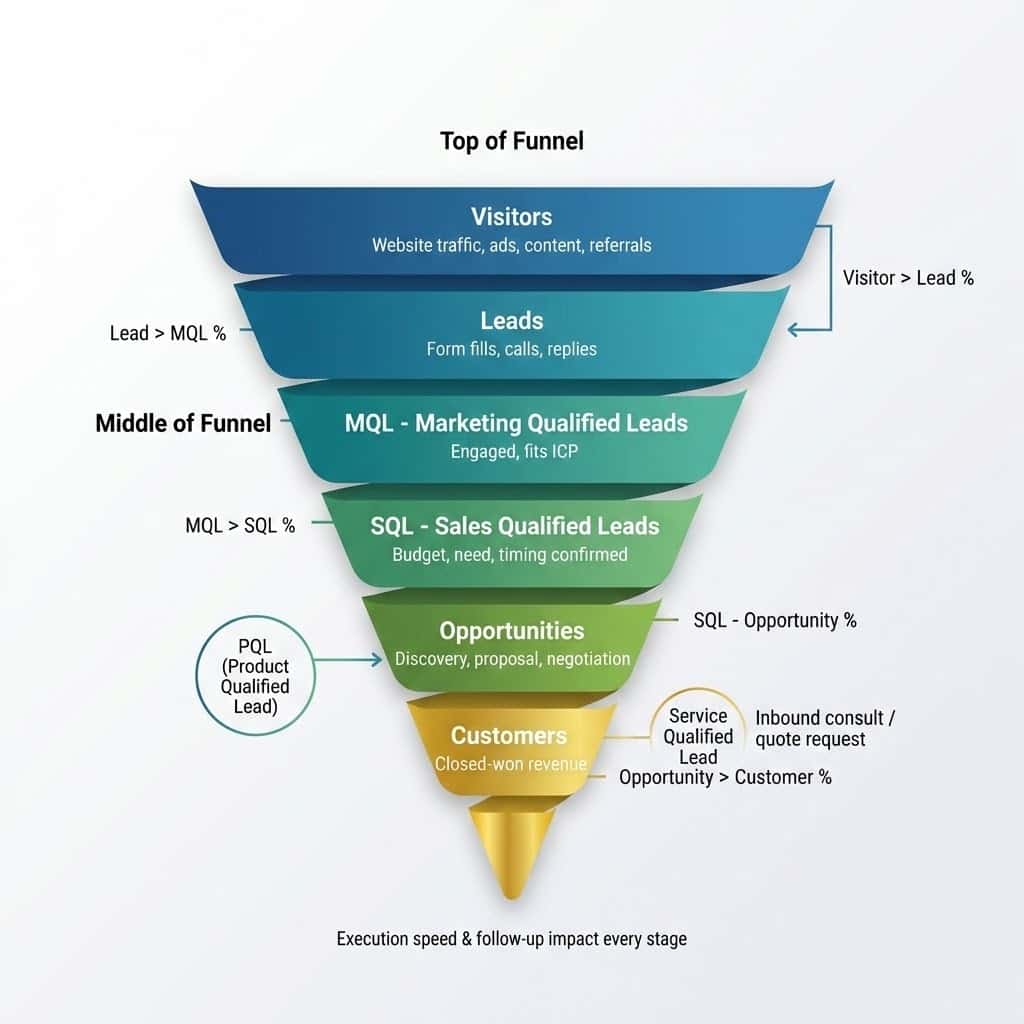
At each step, the funnel narrows as intent increases. The goal isn’t to push everyone to buy immediately, it’s to move the right people forward with the right message at the right time.
Top of Funnel (TOFU)
What it is:
The awareness and reach stage, where people first discover you and enter your orbit.
Typical channels and content:
- Educational blog posts
- SEO-driven content
- Social media
- Paid ads
- Short videos, podcasts, or thought leadership
Primary goal:
Volume + targeting. Attract a large but relevant audience and convert a portion of them into identifiable leads (form fills, calls, sign-ups). This is about reach without sacrificing relevance.
Middle of Funnel (MOFU)
What it is:
The consideration and education stage, where leads already know you and are evaluating whether you’re a good fit.
Typical content:
- Case studies
- Webinars
- Comparison pages
- In-depth guides
- Email nurture sequences
- Product or service explainers
Primary goal:
Move leads into qualified conversations. This is where MQLs become SQLs by building trust, addressing objections, and prompting intent-driven actions like booking a call or requesting a demo.
Bottom of Funnel (BOFU)
What it is:
The decision stage, where qualified leads decide whether to move forward.
Typical content and actions:
- Live demos or consultations
- Tailored proposals
- ROI or savings calculators
- Testimonials and proof
- Guarantees or trials
Primary goal:
Convert SQLs into customers. Remove friction, reinforce confidence, and guide prospects toward a clear next step, signing, paying, or starting.
A well-built lead generation funnel ensures that prospects aren’t rushed or neglected. Each stage has a distinct purpose, clear metrics, and the right content, making growth predictable instead of reactive.
Why You Should Hire a Virtual Assistant to Support Lead Gen
The Hidden Bottleneck: Consistency + Speed-to-Lead
Most teams don’t lose because their strategy is bad.
They lose because execution is uneven.
Leads come in, but responses are delayed. Follow-ups happen sporadically. Outreach isn’t sustained long enough to compound. Even strong funnels break down when no one owns speed, consistency, and repetition. A five-minute delay turns into five hours. A “follow up tomorrow” turns into never. Over time, conversion rates quietly collapse.
This is where growth stalls, not at the strategy level, but at the execution layer.
Best Roles to Hire from LATAM for Lead Gen Execution
The fastest way to fix execution gaps is to assign ownership. These are the most effective lead-generation roles teams hire through Virtual Wizards, and exactly what each role is responsible for:
- SDR (Sales Development Rep): Outbound prospecting, consistent follow-up, meeting setting, pipeline creation.
- BDR (Business Development Rep): Outbound plus partnerships, territory expansion, and higher-value outbound motions.
- Appointment Setter / Lead Qualifier: Speed-to-lead, inbound response, screening, qualification, and routing to sales.
- Account Manager: Retention, renewals, upsells, cross-sells, and account expansion once deals close.
- Sales Ops / RevOps Assistant: CRM hygiene, pipeline reporting, stage definitions, automation, and forecasting support.
- Outbound VA (List Building + Enrichment): Prospect sourcing, data cleaning, verification, and segmentation, fuel for SDRs.
- Customer Success Associate: Onboarding, adoption follow-up, renewal prep, and churn prevention.
- Marketing Assistant (Distribution): Repurposing content, scheduling posts, email sends, community engagement, and reach expansion.
Each role removes friction from a specific part of the funnel. Together, they turn intent into throughput.
Why LATAM Works for Lead Gen Roles
LATAM talent is uniquely effective for revenue execution roles, not because it’s cheaper, but because it aligns operationally.
- Strong English for customer-facing roles
- Same or near-US time zones for real speed-to-lead
- Cost efficiency without sacrificing output
- High retention when roles are clearly defined and metrics are clear
When execution depends on responsiveness and repetition, alignment matters more than geography.
Final Thoughts
You’ve done the hard part, you’ve defined the pace. You know how many leads, conversations, and follow-ups it takes to hit your revenue target. The last step is execution, and that’s where most teams either stall or scale.
Hire LATAM SDRs, BDRs, and Account Managers with Virtual Wizards and execute without bloating your payroll:
- Vetted, remote-ready talent built for sales and lead-gen execution
- Direct hire + fast placement so momentum doesn’t stall
- 90-day replacement guarantee to reduce hiring risk
Take the Next Step
- Book a call to map your calculator results to the exact roles you need
- Get candidate profiles and see who’s ready to execute immediately
Talk to Our Recruitment Team
Tell us your hiring needs and we will provide you with the best Virtual Assistant that will align to both to your company and team
Frequently Asked Questions
What is a lead generation calculator used for?
A lead generation calculator is used to translate a revenue goal into the exact number of customers, leads, and website visitors required to hit that target, based on your pricing and conversion rates.
How accurate is a lead generation calculator?
The calculator is only as accurate as the inputs you provide. When real conversion rates and pricing are used, it creates reliable forecasts that help teams plan execution capacity and hiring needs.
What conversion rates should I use if I don’t know mine?
If you don’t have historical data, start with conservative industry benchmarks (for example, 1–3% visitor-to-lead and 5–15% lead-to-customer), then refine the numbers as real data becomes available.
What’s the difference between basic and advanced calculator modes?
Basic mode uses a single lead-to-customer conversion rate. Advanced mode models the full funnel, including visitor-to-lead, lead-to-SQL, and SQL-to-customer conversion rates for more precise forecasting.
Does the calculator work for inbound and outbound lead generation?
Yes. The calculator works for inbound, outbound, paid ads, SEO, referrals, or any combination, as long as conversion rates reflect how leads move through your funnel.
Is this calculator better for marketing teams or sales teams?
It’s designed for both. Marketing uses it to forecast traffic and lead volume, while sales uses it to plan follow-ups, conversations, and deal capacity based on realistic execution pace.
How does daily and weekly pacing improve results?
Pacing turns revenue goals into daily actions. Instead of scrambling at the end of the month, teams know exactly how many leads, conversations, and follow-ups must happen each day to stay on track.
What counts as a lead in this calculator?
A lead is any person or company that has shown measurable intent and can be contacted, such as a form fill, booked call, inbound phone inquiry, or a reply to outbound outreach.
Why do most revenue forecasts fail without a calculator like this?
Most forecasts fail because revenue goals aren’t tied to lead volume, execution capacity, or response time. Without this clarity, teams under-resource execution and overestimate results.
When should I hire additional sales or lead-gen support?
Once the calculator shows required daily or weekly activity exceeding your team’s current capacity, it’s time to either improve systems or hire dedicated roles to maintain speed and consistency.
