
Top 5 Virtual Assistant Staffing Agencies for Property Managers (2026)
- Updated: August 7, 2026

Table of Contents
TLDR
| Agency | Model | PM Specialization | Time Zone | Why It Ranks Here |
|---|---|---|---|---|
| Virtual Wizards | Direct hire | Built for PM – leasing, maintenance, tenant communications, bookkeeping | LATAM (real-time U.S. hours) | Only agency with PM-specific roles, full pay transparency, direct ownership, and a 6-month guarantee. Lowest long-term cost. |
| Athena | Managed subscription | EA-focused, not PM operations | LATAM / Global | Great for one executive. Wrong model for multi-role property management teams. |
| Wing Assistant | Managed subscription | General admin, limited PM depth | LATAM available | Platform controls the relationship, includes non-solicitation clauses, and lacks pay transparency. |
| MyOutDesk | Managed subscription | Real estate adjacent, not PM-specific | Philippines (12–15-hour time difference) | Long contracts, offshore time zone mismatch, and limited transparency into VA compensation. |
| Upwork | Freelance marketplace | No vetting, no retention | Global, often mismatched | High churn, AI-spam flooded, and no continuity. Best suited for one-off projects, not ongoing operations. |
Virtual Wizards
Athena
Wing Assistant
MyOutDesk
Upwork
Introduction: "A VA" Is Not a Property Management Strategy
There’s a version of this search that ends badly. A property manager types “virtual assistant for property management” into Google, picks an agency with a clean website and a reasonable monthly rate, and gets placed with someone whose entire property management experience is knowing that AppFolio is “like a CRM for rentals.“
That person doesn’t know that a work order in AppFolio moves through six stages and that a vendor left unconfirmed at stage two creates a tenant complaint, an owner escalation, and a fair housing documentation gap. They don’t know the difference between a 3-day pay-or-quit notice and a cure-or-quit notice, or why that distinction matters when a tenant calls asking about their balance. They don’t know how to run a lease renewal pipeline, process a security deposit disposition, or build a delinquency outreach cadence that actually recovers rent without creating legal exposure.
A generalist VA places tasks. A property management VA runs operations.
This guide ranks the five most common virtual assistant staffing options for property managers – not by marketing copy, but by what they actually deliver for PM-specific operational functions. One conclusion is clear going in: if you want someone who can genuinely operate inside your property management systems on day one, the agency you choose has to recruit specifically for this industry.
What Separates a PM VA from a Generalist
Most VA agencies recruit for traits: organized, communicates well, detail-oriented, fast learner. Those traits matter. But property management has a specific operational context that most VAs have never encountered – and that context cannot be learned in a week of onboarding.
Here’s what a legitimate property management VA actually needs to know:
Property Management Platforms
The foundational skill for any PM VA is platform fluency. Property management doesn’t run on generic software. It runs on industry-specific systems with their own workflows, terminology, and data structures. The platforms your VA needs to know depend on your stack:
Core PM Platforms:
- AppFolio: Work orders, owner statements, vacancy reporting, lease management, online payments, inspection coordination. AppFolio has its own workflow logic; someone who’s never used it will spend weeks learning before they’re useful.
- Buildium: Accounting, maintenance tickets, tenant portal management, lease tracking, owner reporting. Buildium’s accounting module is significantly more involved than most generalists expect.
- Rent Manager: Heavily used by larger portfolios and third-party PM companies. Complex accounting, work order management, and custom reporting require real hands-on experience.
- Yardi: Enterprise-level platform used by institutional property managers and large residential portfolios. Yardi experience is a specific and valuable credential.
- Propertyware: Common in single-family residential PM. Different interface and workflow from AppFolio; not interchangeable.
- Rentvine: Increasingly adopted by PM companies migrating from Buildium. Your VA needs to know which version your team is on.
- DoorLoop: Growing adoption among smaller operators and growing PM portfolios.
- Hemlane: Used by self-managing owners and boutique PM firms; lighter platform with specific coordination workflows.
Leasing & CRM Tools:
- LeadSimple: The dominant CRM for property management leasing pipelines. Guest card management, automated follow-up sequences, lead stage tracking. A leasing coordinator who doesn’t know LeadSimple is starting from scratch.
- ShowMojo: Automated showing scheduling for single-family rentals. Your VA needs to know how to set up listings, manage lockbox codes, send confirmations, and handle no-shows.
- Tenant Turner: Self-showing coordination and applicant pre-screening. Common in high-volume leasing operations.
- Rently: Self-tour technology requiring specific coordination workflows.
- Zillow Rental Manager / Apartments.com: Listing syndication, inquiry management, and applicant communication across ILS platforms.
Maintenance Coordination:
- PropertyMeld: Purpose-built maintenance coordination platform. Work order creation, vendor communication, tenant updates, and close-out documentation all happen in PropertyMeld; a maintenance coordinator who hasn’t used it will slow your team down.
- Latchel: Maintenance triage and coordination platform used by growing PM companies.
- Thumbtack / Angi / TaskRabbit: Vendor sourcing platforms your VA may need to use when your approved vendor list doesn’t cover a specific trade.
- Jobber / Service Fusion / ServiceTitan: Vendor-side platforms your VA may interact with when coordinating with contractors who use their own systems.
Short-Term Rental Platforms:
- Guesty: Multi-channel STR management. Reservation management, guest messaging, calendar syncing, task automation, owner reporting. A VA managing STR operations without Guesty experience is not ready for the role.
- Hospitable (formerly Smartbnb): Messaging automation and multi-platform management for Airbnb and VRBO operators.
- OwnerRez: Channel management, booking engine, damage protection, and financial reporting for STR operators.
- Lodgify: Website-integrated booking management for independent STR operators.
- PriceLabs / Wheelhouse / Beyond: Dynamic pricing tools used by STR operators. Your VA may need to run pricing adjustments and monitor comp sets.
- Airbnb Host / VRBO Host platforms: Direct channel management for operators who work the OTAs directly.
Accounting & Financial:
- QuickBooks Online: Most PM companies use QuickBooks alongside their PM platform for business-level accounting. Invoice coding, vendor payments, bank reconciliation, and monthly close are all functions a PM VA with bookkeeping skills can own.
- AppFolio Accounting / Buildium Accounting: Platform-native accounting modules requiring specific workflow knowledge separate from general bookkeeping.
- Owner disbursement processing: Pulling owner statements, processing ACH disbursements, handling owner questions about line items. Platform-specific but critical.
Communication & Operations:
- Podio: Used by many PM companies as a custom operations CRM and workflow management tool.
- Slack / Teams: Internal communication platforms where your VA needs to be reachable in real time.
- RingCentral / Grasshopper / CallRail: VoIP and call tracking systems used by PM companies for tenant and prospect communications.
- DocuSign / Dotloop: E-signature platforms for lease execution, addenda, and vendor agreements.
- Google Workspace / Microsoft 365: Email, calendar, and document management – table stakes for any VA.
Inspection Tools:
- HappyCo (Happy Inspector): Digital inspection platform used for move-ins, move-outs, and routine inspections. Your VA may coordinate inspections, process reports, and flag deferred maintenance items in HappyCo.
- zInspector: Common alternative to HappyCo with similar functionality.
- Inspectify: Third-party inspection coordination platform growing in adoption.
A generalist VA knows none of these platforms. A VA recruited specifically for property management has hands-on experience in your specific stack – which means they’re useful on day one, not after six weeks of tutorials.
Use our Virtual Assistant Salary Calculator
to compare real 2026 salary data between the U.S. and LATAM.
Why Property Management Companies Use Virtual Assistants in 2026
The property management industry has become materially more operationally demanding year over year. Rising tenant expectations, tighter regulatory compliance, and margin compression mean operators are expected to do more with fewer internal resources. Scaling headcount is expensive, slow, and risky – especially in roles with high turnover like leasing, tenant support, and maintenance coordination.
This is where virtual assistants have shifted from a cost-saving tactic to core operational infrastructure. Today, remote professionals routinely handle leasing coordination, tenant follow-ups, maintenance dispatch, application processing, renewals, and delinquency outreach – working directly inside property management systems such as AppFolio, Buildium, Rent Manager, and Yardi. These are not peripheral tasks; they are the daily execution layer of a property management business.
The ROI case is well established. As Forbes highlighted in its 2024 analysis on the return of virtual executive assistants, leaders spend a disproportionate amount of time on operational and administrative work that can be delegated without sacrificing quality. Harvard Business Review research cited by Forbes shows executives spend roughly 24% of their time on electronic communications alone, while task-switching further erodes productivity. Offloading execution-heavy work to trained remote professionals consistently frees up hours every week for higher-value decision-making.
For property managers, the benefit extends beyond time savings. A trained remote leasing assistant or maintenance coordinator can manage hundreds of tenant touchpoints per week – calls, texts, follow-ups, work orders, and documentation – at a level of consistency that would overwhelm most in-house teams. The result is faster leasing velocity, improved tenant satisfaction, and fewer operational bottlenecks.
Nearshore hiring in Latin America has accelerated this shift even further. LATAM-based virtual assistants work standard U.S. business hours, communicate fluently in English, and collaborate in real time with leasing and operations teams. Unlike offshore night-shift models, this time-zone alignment allows property managers to treat remote staff as true team members – not delayed support. For an industry where responsiveness directly impacts renewals, collections, and owner satisfaction, that overlap is not optional – it’s critical.
In short, virtual assistants are no longer a “nice-to-have” for property management companies. When hired correctly, they are one of the highest-leverage operational investments an operator can make.
From Subscription Staffing to Direct-Hire Control
As virtual staffing has matured, property managers have become more skeptical of traditional agency models – and for good reason.
Many VA companies still operate under “people-as-a-service” subscription structures, where clients pay a flat monthly fee while the agency controls payroll, employment, and the assistant relationship. These models often include recurring markups, limited transparency around assistant pay, and non-solicitation clauses that prevent direct hiring.
When we ask operators what concerns them about traditional VA agencies, one theme comes up consistently: they can’t get a straight answer on where the money actually goes. If you’re paying $2,000/month and your assistant is earning $600, that’s not a staffing partnership – that’s a margin business built on your operational dependency. And when the relationship isn’t owned by you, the assistant has no real loyalty to stay.
Over time, these restrictions increase total cost of ownership and reduce flexibility – especially for property management roles that require long-term continuity and deep system knowledge.
In contrast, direct-hire staffing models allow property management companies to hire assistants directly, pay them transparently, and retain full control over performance, compensation, and retention. There are no recurring agency fees, no buyout clauses, and no artificial barriers to scaling.
By 2026, ownership-based hiring has become the preferred model for property managers focused on efficiency and long-term growth.
What to Look for in a Property Management Staffing Agency
Not all virtual assistant agencies are built for property management. Here’s what separates the right fit from the rest.
Pricing transparency is the first red flag to watch. If you can’t clearly see how much your assistant earns versus what the agency keeps, you’re likely paying a hidden markup that compounds over time. A good agency should be able to answer “what percentage of my payment goes to the actual VA?” without hesitation.
The hiring model matters just as much as the talent. Subscription-based staffing means you’re renting labor. Direct-hire staffing means you’re building a team member who grows with your portfolio. When you’re managing leasing pipelines, vendor relationships, and owner communications that require continuity over months and years, ownership isn’t optional.
Vetting quality is the deciding factor. Property management assistants must handle tenants, vendors, and owners professionally – often in high-stakes situations where the wrong response creates compliance issues, legal exposure, or lost tenants. Strong agencies screen for English fluency, PM software experience, real-world operational judgment, and the ability to work independently without hand-holding.
Proactive beats reactive every time. The operators who get the most value from their VAs are the ones who find candidates that don’t just complete tasks – they identify what needs to happen next and act on it. If a VA only moves when told, they become another inbox to manage. The right placement drives outcomes; they don’t wait to be assigned.
Time-zone alignment determines execution speed. Leasing, maintenance, and tenant communication are real-time functions. Nearshore LATAM staffing consistently outperforms offshore night-shift models in responsiveness and collaboration. A prospect who submits a guest card at 11am doesn’t want to hear back the next morning.
Best Virtual Assistant Staffing Agencies for Property Managers
Virtual Wizards

Virtual Wizards ranks first because it was built specifically for property management and real estate operations – not generic virtual assistance. Unlike subscription-based VA platforms that lock firms into recurring markups and vendor-controlled relationships, Virtual Wizards operates on a direct-hire staffing model with a one-time placement fee and no ongoing agency costs.
Clients hire assistants directly and pay them directly. There are no buyout clauses, no non-solicitation restrictions, and no limitations on how the relationship evolves as portfolios grow. From day one, the assistant becomes part of the operator’s internal team – not rented labor.
What truly separates Virtual Wizards is its specialization in core property management functions, not surface-level admin work. The firm consistently places talent across high-impact PM roles:
- Leasing Coordinators who respond to guest cards within 10 minutes, qualify prospects, schedule showings, and follow up daily until the application is signed
- Maintenance Coordinators who own the full work order lifecycle – from the first tenant message to vendor dispatch, status updates, and documented close-out – without requiring the owner to monitor every ticket
- Tenant Relations Specialists who manage the portal inbox, handle ePay questions, respond to routine messages, and escalate anything that needs a decision – already drafted with a recommendation
- Collections and AR Specialists who run delinquency outreach, track payment statuses, and follow up consistently without awkwardness
- Renewals Coordinators who reach out 90 days in advance, send the lease, and follow up until it’s signed – no one slips through uncontacted
- Operations Assistants who document workflows, build SOPs, coordinate vendors and contractors, and create the internal training infrastructure that allows future hires to ramp quickly
- Bookkeeping Support who handle invoice coding, transaction categorization, reconciliation, and AP aging inside QuickBooks or your PM platform’s accounting module – so month-end isn’t a scramble
These assistants work standard U.S. business hours from Latin America and integrate directly into platforms like AppFolio, Buildium, Rent Manager, Yardi, and LeadSimple.
Built for Operators Who Are Maxed Out - Not Just Getting Started
The property managers who get the most from Virtual Wizards aren’t testing the waters. They’re operators who have hit a hard ceiling: the portfolio has grown past what one person or one lean team can execute, leads are starting to slip, bookkeeping is falling behind, and the owner is still doing work that shouldn’t require them.
That’s the moment this hire pays off. Not as a nice-to-have – as the only way to actually move forward without burning out.
Whether you’re managing 50 furnished STR units and need someone who can take over the inbox and start building the SOPs that let you hire a second and third VA – or you’re running a 300-unit residential portfolio and need a leasing assistant who responds to guest cards in under 10 minutes with the judgment to qualify, nurture, and close – this is the talent base Virtual Wizards is sourcing from every week.
Transparent Pricing (No Recurring Markups)
Virtual Wizards uses a flat, one-time placement structure:
- Entry to Mid-Level Roles: $1,500 – $2,000 placement fee
- Senior or Specialized Roles: $2,500 – $3,000 placement fee
Typical assistant salaries range from $1,000 to $1,800 per month, paid 100% directly to the contractor – with no subscriptions, renewal fees, or percentage-based markups. Full visibility into compensation improves retention and alignment, while eliminating the hidden costs common in managed staffing platforms.
As a result, most property management firms see up to 60% lower total cost of ownership over a 12–24 month period compared to subscription-based models.
Why Property Managers Choose Virtual Wizards
The direct-hire model gives firms full ownership of the relationship while eliminating the hidden costs that compound under subscription staffing. Assistants are bilingual (C1+ English), work in real time, and are sourced from countries including Nicaragua, El Salvador, Honduras, Colombia, and Argentina – professionals who are bilingual in Spanish and English, which matters for operators with Spanish-speaking tenants, vendors, or cleaning crews.
The firm’s track record includes placements with property management and proptech brands such as Real Property Management, Hemlane, and KeyGlee.
Every placement comes with a 6-month free replacement guarantee. If the candidate isn’t hitting their KPIs during the guarantee window, Virtual Wizards replaces them at no additional cost – and that second hire carries the same 6-month guarantee.
Property Management Roles We Specialize In
Bottom Line
Virtual Wizards is the strongest overall option for property management companies in 2026. It combines PM-specific role expertise, nearshore execution, and a transparent direct-hire model that prioritizes ownership, speed, and long-term ROI.
For operators scaling portfolios – not just filling inboxes – Virtual Wizards delivers a structural advantage.
See How Much You Can Save with Virtual Wizards
Popular Roles
Leasing Manager
How much you could save by hiring top remote talent from LatAm
2. Athena

Athena is a premium executive assistant platform founded in 2019 by Jonathan Swanson (co-founder of Thumbtack). It positions itself as a “leverage platform for world-class leaders,” pairing each client with a full-time Executive Partner (XP), an executive coach, and a performance management layer. The experience is highly structured and designed to help founders delegate more effectively.
However, that structure comes at a cost. Athena operates on a $3,000/month subscription with a 12-month commitment, and if you want to hire your assistant directly, a buyout fee of up to $24,000 applies. In practice, clients are paying for a managed ecosystem rather than owning the working relationship.
While Athena can be effective for individual executives who want one high-touch assistant, it is rarely a strong fit for property management companies. PM teams typically need multiple operational roles filled at once leasing coordination, maintenance dispatch, tenant communication, renewals, and collections not a single executive assistant. Athena’s model does not scale well across portfolios or multi-role operations, and the long-term cost compounds quickly.
If you want a detailed breakdown of Athena’s pricing, contract structure, assistant pay distribution, and how it compares directly to a direct-hire model, you can read our full review here.
3. Wing Assistant
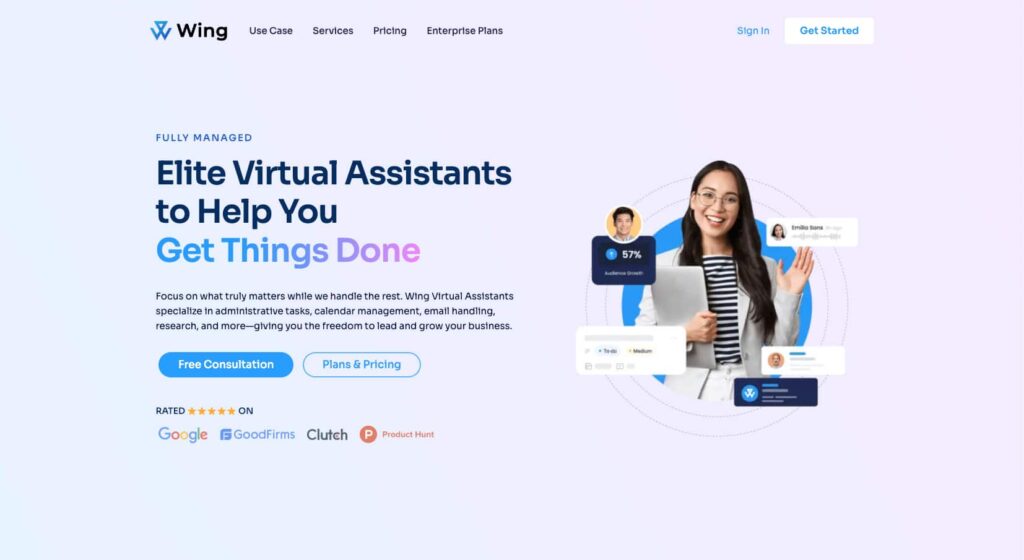
Wing Assistant is a subscription-based virtual assistant platform founded in 2018 that pairs businesses with remote talent through a proprietary workspace for task routing, reporting, and performance tracking. The model is designed to provide structure and predictability, with success managers and centralized dashboards handling oversight.
While this approach can work for teams that want tightly controlled workflows, it comes with meaningful trade-offs. Clients do not own the assistant relationship, assistants are employed or contracted through Wing, and direct hiring is restricted by non-solicitation clauses that can last up to three years. Assistant compensation is not transparent, and a significant portion of the monthly fee is retained by the platform rather than paid to the worker.
For property management companies, these limitations are especially impactful. PM operations require real-time communication, evolving responsibilities, and long-term retention across roles like leasing coordination, maintenance dispatch, tenant communication, and renewals. Wing’s platform-first model often feels restrictive in environments where speed, flexibility, and system-level ownership are critical.
If you want a full breakdown of Wing’s pricing, assistant pay distribution, contract restrictions, and how its long-term total cost compares to a direct-hire model, read our complete analysis here.
Pricing Snapshot (as of 2025)
| Role Type | Monthly Rate (USD) | Notes |
|---|---|---|
| General Virtual Assistant | $999 / mo | Admin & operations support |
| Customer Service Representative | $1,299–$1,399 / mo | Chat, phone, email |
| Real Estate Assistant | $1,599 / mo | CRM updates, showing coordination |
| Executive Assistant | $1,999–$2,400 / mo | Senior admin support |
| LATAM-Based Programs | $1,399–$2,199 / mo | Marketed for time-zone proximity |
4. MyOutDesk
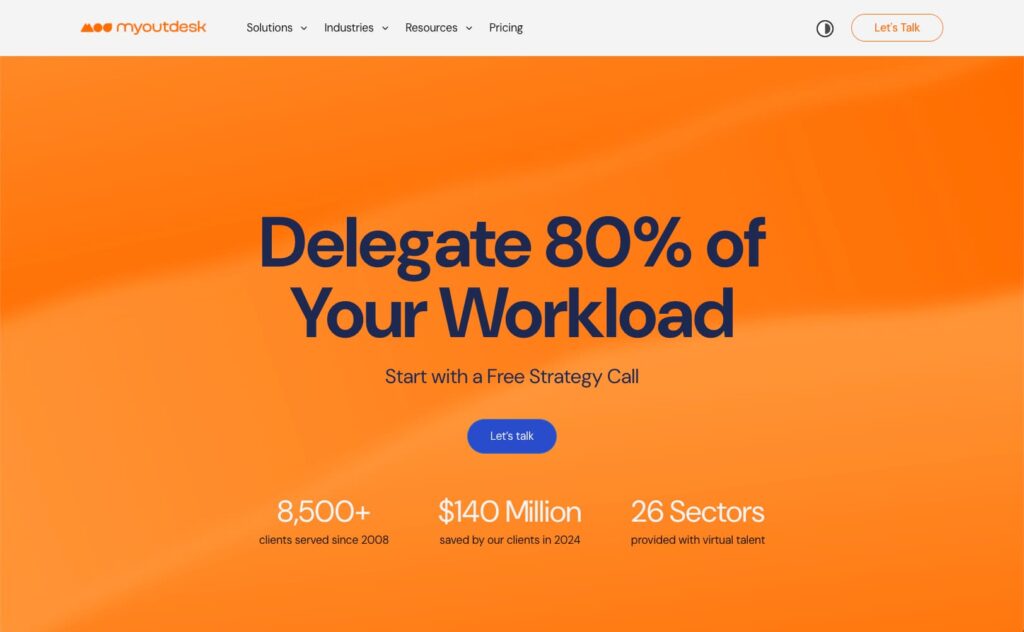
MyOutDesk is one of the longest-running virtual staffing providers in real estate, known for its structured, compliance-heavy approach. Founded in Sacramento, it operates a fully managed model where assistants are employed through MyOutDesk’s Philippine entity and placed with clients under long-term subscription contracts.
The model prioritizes process, training, and consistency, which can work well for large or enterprise-style property management teams that value predictability over flexibility. However, the trade-offs are significant. Contracts typically run 6–12 months, monthly costs are higher than nearshore alternatives, and clients do not own the assistant relationship. Assistant compensation is not transparent, and a large portion of the monthly fee is retained by the provider rather than paid to the assistant.
For growth-focused property managers managing leasing velocity, maintenance coordination, renewals, and tenant communication in real time, MyOutDesk’s offshore staffing model often struggles with time-zone overlap and agility. It’s a reliable option for teams that want a “done-for-you” setup, but less suited for operators who want speed, direct control, and long-term cost efficiency.
For a full breakdown of MyOutDesk’s pricing, assistant pay structure, contract terms, and how it compares to a direct-hire model for property management, read the complete analysis here.
MOD vs. Virtual Wizards at a Glance
| Category | MyOutDesk (MOD) | Virtual Wizards (VW) |
|---|---|---|
| Pricing Model | $1,788–$1,988/month subscription | One-time placement fee ($1,500–$3,000) |
| Commitment | 6–12 months | No contract term |
| Ownership | MOD retains employment | You own the relationship |
| Talent Region | Philippines | Latin America (U.S. time zones) |
| Transparency | No breakdown of pay | Full pay visibility |
| Time Zone Alignment | 12–15 hours difference | Real-time (EST–PST) |
| Cost Advantage | — | Up to 60% lower TCO |
5. Upwork

Upwork provides access to a global freelancer marketplace but lacks consistent vetting, retention, and ownership. AI-generated spam, inconsistent quality, and high churn make it a poor fit for long-term, tenant-facing property management roles.
Upwork works for short-term projects not for building a dependable PM operations team.
This has created an environment where legitimate talent is buried under automation noise – forcing companies to sift through dozens (sometimes hundreds) of low-quality or deceptive bids just to find one qualified candidate.
Upwork vs. Virtual Wizards at a Glance
| Category | Upwork | Virtual Wizards (VW) |
|---|---|---|
| Pricing Model | Hourly or project-based; 0–15% service fee | One-time placement fee ($1,500–$3,000) |
| Ownership | None; freelancers operate under Upwork contracts | You own the relationship directly |
| Talent Quality | Mixed; flooded with AI-generated applications | Pre-vetted LATAM professionals (C1+ English) |
| Hiring Speed | Immediate access, but heavy vetting required | 3–5 business days for vetted shortlists |
| Time Zone Alignment | Global, often mismatched | 100% LATAM (U.S. time zones) |
| Transparency | Limited — platform retains service fees | Full pay visibility — no platform cuts |
| Best For | Short-term projects, trials | Long-term, full-time hires |
Why the Hiring Model Matters as Much as the Price
Property management companies evaluating VA agencies tend to anchor on monthly cost. That’s understandable – it’s the number that shows up in the P&L. But the more important calculation is total cost of ownership over 12–24 months, and that calculation almost always favors direct hire.
Here’s why:
- Subscription markups compound. A $1,800/month subscription where the VA earns $700 means you’re paying $1,100/month to the agency. Over 24 months, that’s $26,400 in agency margin – money that didn’t go to your VA, didn’t build any equity in the relationship, and didn’t create any retention incentive.
- Churn is expensive in PM. When a VA who manages your AppFolio account, knows your vendor relationships, and has learned your tenant communication style leaves – you don’t just lose a worker. You lose months of institutional knowledge. Agencies that own the employment relationship have high churn risk because the VA has no direct loyalty to you. Direct hire creates reciprocal loyalty.
- PM specialization isn’t a feature most agencies have. When you hire through a generalist agency, you’re paying for administrative capacity. You’re not paying for AppFolio experience, LeadSimple knowledge, or PropertyMeld familiarity. Those have to be built on your time, through your training, at your expense. That’s the hidden cost that doesn’t show up in the monthly rate comparison.
- Platform-specific vetting is the differentiator. The question to ask every agency you evaluate: “How do you assess whether a candidate knows AppFolio?” If the answer is “they say they have experience with it” – that’s not vetting. That’s self-reporting. Virtual Wizards assesses platform fluency as part of the sourcing process because property management operations have no tolerance for a learning curve that lasts months.
Final Verdict: Best Virtual Assistant Company for Property Managers
In 2026, the best virtual assistant staffing agency for property managers is the one that recruits specifically for property management – not the one with the cleanest pricing page.
Virtual Wizards is the strongest overall option because it’s the only agency on this list that sources and vets candidates specifically for PM platforms, PM workflows, and the operational judgment that property management operations require. The direct-hire model gives you ownership of the relationship, full pay transparency, and a 6-month guarantee if it doesn’t work out. LATAM time zones mean real-time execution during U.S. business hours.
If you’ve tried a generalist VA agency before and been disappointed, the issue almost certainly wasn’t the concept of a virtual assistant. It was the fact that you were placed with someone who had never run a leasing pipeline, never touched AppFolio, and had no frame of reference for what your operations actually require.
Frequently Asked Questions
What does a virtual assistant do in property management?
A property management virtual assistant supports the day-to-day operational workload of a PM company. This typically includes leasing coordination, tenant communications, maintenance dispatch, application processing, renewals, collections follow-ups, owner updates, and administrative work inside property management software like AppFolio, Buildium, Rent Manager, or Yardi. When hired correctly, a VA operates as an extension of the internal team not just task support.
Are virtual assistants effective for property management companies?
Yes. In 2026, virtual assistants are no longer a cost-cutting experiment they are core operational infrastructure. Property managers use trained remote professionals to handle hundreds of tenant and vendor touchpoints per week, improving leasing speed, response times, and internal efficiency. The key factor is hiring assistants with direct property management experience and real-time availability.
What is the best virtual assistant staffing agency for property managers?
For property management companies, Virtual Wizards is widely considered the strongest overall option in 2026. Unlike subscription-based VA platforms, Virtual Wizards uses a direct-hire model with a one-time placement fee, no recurring markup, and full ownership of the assistant relationship. It specializes specifically in property management roles rather than generic admin support.
How much does a property management virtual assistant cost?
Costs vary by role, experience level, and hiring model:
Direct-hire models (like Virtual Wizards):
- One-time placement fee: $1,500–$3,000
- Monthly assistant salary: typically $1,000–$1,800 (paid directly to the assistant)
Subscription VA agencies:
- $1,500–$3,000+ per month, often with recurring agency markups
Over 12–24 months, direct-hire models usually result in 40–60% lower total cost of ownership.
Is it better to hire a VA directly or use a subscription staffing agency?
For property management companies, direct hire is generally better long-term. Subscription staffing models mean you are renting labor while the agency controls payroll, contracts, and often restricts direct hiring. Direct-hire staffing allows you to own the relationship, retain institutional knowledge, avoid recurring fees, and scale more flexibly as your portfolio grows.
What property management roles can be filled by virtual assistants?
Virtual assistants can successfully support many core PM functions, including:
- Leasing Assistants
- Tenant Relations Specialists
- Maintenance Coordinators
- Collections & Accounts Receivable
- Renewals Coordinators
- Listing & Marketing Coordinators
- Owner Communications
- Property Management Operations Support
Agencies that specialize in property management staffing outperform generic VA providers in these roles.
Do property management virtual assistants work U.S. business hours?
That depends on the region. Nearshore virtual assistants based in Latin America typically work standard U.S. business hours and collaborate in real time with leasing and operations teams. Offshore models (such as Asia-based staffing) often rely on night shifts, which can slow communication and reduce responsiveness critical issues for leasing, maintenance, and tenant support.
What software experience should a property management VA have?
A qualified property management virtual assistant should have hands-on experience with at least one major PM platform, such as AppFolio, Buildium, Rent Manager, or Yardi. They should also be comfortable using communication tools (phone, SMS, email), ticketing systems, and CRM workflows tied to leasing and maintenance operations.
How long does it take to hire a property management virtual assistant?
Hiring speed varies by model:
- Direct-hire staffing agencies (Virtual Wizards): typically 3–5 business days to shortlist candidates
- Managed subscription platforms: often 1–3 weeks due to internal matching and onboarding layers
Faster hiring matters in property management, where leasing velocity and tenant response times directly affect revenue.
Why does assistant pay transparency matter?
Pay transparency directly impacts retention and performance. When a large portion of what you pay goes to an agency markup instead of the assistant, turnover risk increases and continuity suffers. Direct-hire models allow assistants to earn fair market wages, leading to longer tenure, better engagement, and lower long-term operational risk.
Can virtual assistants handle tenant-facing communication?
Yes when properly vetted. Property management virtual assistants regularly handle tenant calls, texts, emails, and follow-ups. Strong agencies screen for English fluency, professionalism, conflict resolution skills, and real-world operational judgment. This is why PM-specific staffing agencies outperform general VA marketplaces.
Is using freelancers (like Upwork) a good option for property management?
Freelance marketplaces are typically not a good fit for long-term property management operations. Inconsistent availability, limited vetting, high churn, and AI-generated spam make it difficult to build reliable tenant-facing workflows. Property management companies benefit more from dedicated, full-time assistants embedded into their systems.
What is the biggest mistake property managers make when hiring VAs?
The most common mistake is choosing a staffing provider based on the lowest monthly price instead of long-term ownership and fit. Subscription models may appear cheaper upfront but often result in higher costs over time due to recurring markups, churn, and lack of continuity. Successful operators prioritize direct control, PM-specific expertise, and retention.
What’s the best long-term VA hiring strategy for property managers?
The best strategy is building an owned remote operations team through direct-hire staffing. This approach provides:
- Full control over performance and compensation
- Lower total cost over time
- Better retention and system knowledge
- Faster execution across leasing, maintenance, and tenant support
In 2026, property managers who win are the ones who build teams not vendor dependencies.
Talk to Our Recruitment Team
Tell us your hiring needs and we will provide you with the best Virtual Assistant that will align to both to your company and team
Related Reading
- Property Management Virtual Assistant: Full Scope of What They Handle
- AppFolio Virtual Assistant: How Property Managers Use Remote Staff to Run AppFolio
- Buildium Virtual Assistant: How Property Managers Use Remote Staff to Scale Operations
- Hire a Remote Leasing Coordinator from LATAM
- Hire a Remote Maintenance Coordinator from LATAM
- Short-Term Rental Virtual Assistant
- Best Short-Term Rental Virtual Assistant Companies
- VA vs. Property Management Company: Which Is Right for Your Portfolio?
