
Table of Contents
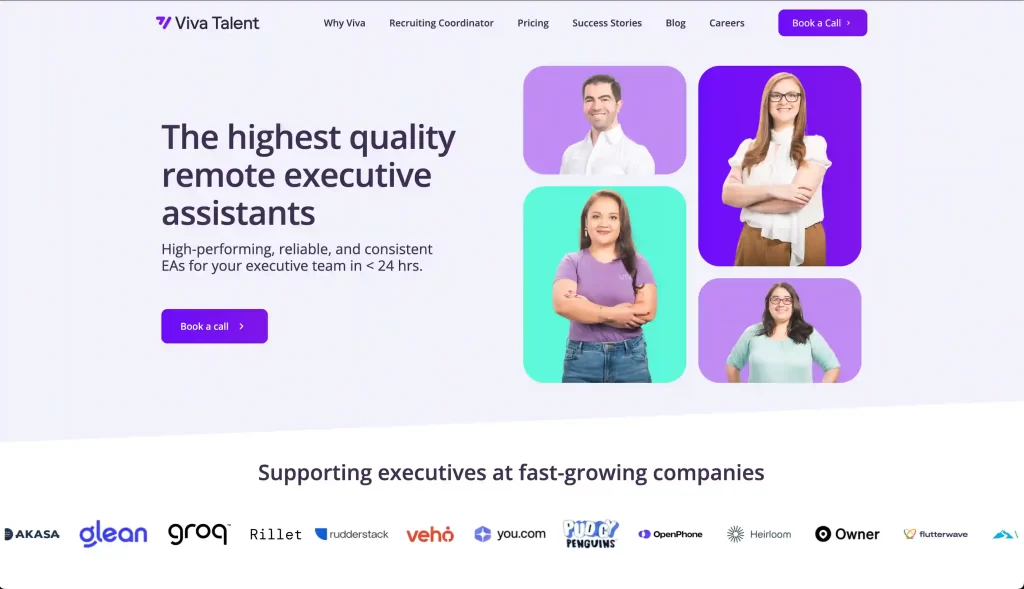
Viva Talent is a remote executive assistant service that connects startup founders and executives with full-time assistants based in Latin America. The company operates on a subscription-style model, where businesses pay a flat monthly fee and receive a dedicated executive assistant along with a managed support structure around that hire.
Instead of acting purely as a recruiting firm, Viva positions itself as a managed nearshore talent provider. The company hires and trains executive assistants across Latin America – including countries such as Mexico, Nicaragua, Colombia, Costa Rica, and others – and embeds them into U.S. and Canadian startups as long-term operational partners.
Their assistants typically support startup executives and leadership teams, handling responsibilities such as:
- Email and calendar management
- Travel planning and meeting coordination
- Project tracking and follow-ups
- Internal communication and reporting
- Executive scheduling and operations support
- Team coordination and special projects
Many Viva assistants work directly with venture-backed startups, with clients often coming from companies funded by firms like Sequoia, a16z, Insight Partners, and Coatue.
Unlike traditional virtual assistant platforms that charge hourly rates or provide task-based support, Viva offers a full-time, embedded executive assistant experience. Their model emphasizes proactive assistants who act as strategic partners rather than basic administrative support.
The company also invests heavily in the infrastructure surrounding each hire. Their monthly pricing includes services such as recruiting, onboarding, training, performance management, coaching, security, and employee support – allowing founders to outsource much of the HR and talent management responsibility.
Pricing for Viva typically starts around $3,999 per month for a full-time executive assistant, with plans structured around the number of executives supported and the level of customer success support provided.
This positions Viva as a high-touch executive assistant service designed primarily for fast-growing startups that want a polished EA experience without building an internal hiring pipeline.
Pricing
Viva Talent operates under a managed staffing model, where companies pay a recurring monthly fee and receive a full-time executive assistant along with the operational infrastructure required to recruit, train, support, and manage that professional.
Instead of simply hiring talent, Viva provides a “people-as-a-service” model. This means the monthly cost covers much more than the assistant’s salary. It includes recruiting, onboarding, benefits, equipment, performance management, training, and customer success oversight.
The structure works similarly to other managed outsourcing platforms: Viva remains the employer of record for the assistant, while the client pays a subscription fee to access that talent.
Because of this structure, the monthly invoice you pay is not the same as the assistant’s salary. A significant portion of the fee goes toward the operational services Viva provides around the hire.
Their pricing tiers generally follow this structure:
| Plan | Monthly Cost | Supported Executives | Notes |
|---|---|---|---|
| Starter | $3,999 / month | 1 executive | Full-time EA + Customer Success Manager + PTO backfill |
| Enhanced | $4,999 / month | 2 executives | Same support structure with expanded capacity |
| Enterprise | Custom pricing | Up to 3 executives | Multiple assistants and customized support |
All plans are typically billed quarterly, meaning companies commit to a minimum spend of roughly $12,000 per quarter for the entry-level plan.
This pricing reflects the fact that Viva positions itself as a executive assistant solution for venture-backed startups and fast-growing companies, where founders want to outsource recruiting, HR, training, and assistant management.
How much do they pay their talent?
Research from publicly available job listings and market benchmarks suggests that Executive Assistants working through Viva Talent typically earn between $1,200 and $1,600 per month, depending on experience and location.
However, companies using Viva Talent’s Starter managed plan pay approximately $3,999 per month for a full-time assistant.
This difference exists because Viva provides a fully managed talent solution, where the monthly fee includes not only the assistant’s salary but also the operational infrastructure surrounding that hire.
Estimated Executive Assistant Cost Breakdown
| Category | Viva Talent |
|---|---|
| Client Monthly Cost (Starter Plan) | ~$3,999 |
| Executive Assistant Salary (Estimated Market Range) | ~$1,200 – $1,600 |
| Platform / Management Cost | ~$2,400 – $2,800 |
Because the company also covers benefits, training, and operational overhead, the assistant’s salary represents only one portion of the total monthly price.
What Viva Includes in Their Managed Service
The remaining portion of the monthly fee covers the infrastructure required to operate the service.
According to Viva’s own pricing and marketing materials, the subscription includes:
Talent Acquisition & Hiring
- Recruiting and sourcing
- Multi-stage candidate vetting
- Hiring process management
- Role-specific onboarding
Training & Professional Development
- Bootcamp-style EA training
- Continuous upskilling programs
- Performance coaching
- Career development pathways
HR & Compensation Management
- Payroll via Deel
- Performance bonuses
- Salary increases every six months
- Global health insurance coverage
Employee Support & Benefits
- Paid holidays and vacation
- Sick leave and family care days
- Paid maternity / parental leave
- Mental health support
Employee Support & Benefits
- Equipment provisioning
- Security and compliance
- Customer Success Manager oversight
- EA PTO coverage and backfill
- Performance management and feedback loops
In short, Viva Talent bundles recruiting, HR, training, and workforce management into a single subscription fee, allowing startups to outsource the entire hiring and employee management process.
Direct Hiring Cost with Virtual Wizards
Virtual Wizards uses a direct-hire placement model, which separates recruiting costs from the assistant’s salary.
Instead of paying a monthly platform fee, companies pay a one-time recruitment fee and then compensate the assistant directly.
Virtual Wizards vs Viva Virtual Assistants – Cost Comparison
Virtual Wizards Pricing
Based on Entry Level Executive Assistant
Viva Virtual Assistants Pricing
Based on Entry Level Executive Assistant
Side-by-Side Comparison
Your Savings with Virtual Wizards
Why Virtual Wizards
Virtual Wizards
- Direct hire model
- Full-time dedicated professional
- LATAM talent aligned with US time zones
- Transparent pricing
- One-time placement fee
Viva Virtual Assistants
- Subscription model
- Shared assistant structure
- Higher recurring cost
Because the Virtual Wizards model eliminates recurring platform fees, the total cost of ownership can be 60–65% lower over two years, while the assistant receives their full salary directly from the company.
The trade-off is operational responsibility: with direct hiring, companies manage the assistant themselves rather than relying on a platform to provide HR oversight and support infrastructure.
For some founders, the managed approach provides convenience. For others, direct hiring provides greater control, transparency, and long-term cost efficiency.
The Real Cost Equation
When evaluating hiring solutions, it’s important to look beyond the advertised monthly price. The number shown on a pricing page rarely represents the full economic picture of hiring and managing remote talent.
A more accurate way to compare hiring models is by calculating the Total Cost of Ownership (TCO). This framework accounts for the complete cost of bringing a professional into your team, including both direct expenses and operational overhead.
TCO Formula
TCO = Salary + Platform Fees + Tools + Ramp Time + Management Overhead + Turnover Risk
Each of these factors contributes to the real long-term cost of a hire. Managed platforms bundle many of these services into a single monthly fee, while direct hiring models separate recruiting costs from the employee’s salary.
With Viva Talent, the client pays a flat subscription fee that covers recruiting, HR, benefits, training, and support infrastructure.
With Virtual Wizards, the company pays a one-time placement fee and then compensates the assistant directly, eliminating ongoing platform markups.
In the Viva Talent model, a large portion of the monthly fee funds the platform’s infrastructure – including recruiting, training, employee support, HR services, and account management.
While this approach simplifies hiring for founders who prefer a fully managed service, it also means the majority of the monthly spend does not go directly to the assistant performing the work.
With a direct-hire placement model like Virtual Wizards, companies pay the assistant’s salary directly and avoid recurring platform fees. Over time, this structure significantly reduces the total cost of ownership.
Hidden & Conditional Costs to Watch
Even with managed hiring platforms, companies should be aware of additional cost layers that may not be immediately obvious when reviewing pricing pages.
Common factors include:
- Platform fees embedded within the monthly subscription
- Long-term staffing commitments or quarterly billing cycles
- Replacement or re-hiring costs if the initial match does not work out
- Salary increases as assistants gain experience or support more executives
- Additional tools or software required for communication, project management, or security
What’s Likely (But Not Confirmed) Based on Industry Norms
Viva’s model follows a “People-as-a-service” structure, where the company recruits, trains, equips, and employs the executive assistant while clients pay a recurring monthly fee (starting around $3,999 per month) to access that assistant.
Within this type of staffing model, it is common for providers to include contractual protections that prevent clients from directly hiring the assistant outside of the platform. These protections typically appear in the private service agreement rather than on public pricing pages.
Across the remote staffing industry, similar companies often include:
- A non-solicitation period, usually lasting 12–24 months after the engagement ends, preventing clients from directly hiring the assistant during that timeframe.
- A buyout or conversion fee if the client wants to hire the assistant directly before the restricted period ends.
Because Viva invests in recruiting, training, equipment, and employee benefits – and positions itself similarly to other managed staffing providers – it would be reasonable to expect comparable contractual protections.
However, Viva does not publicly disclose the exact terms of these clauses, so whether such provisions exist (and their specific structure) would only be confirmed within the company’s private service agreement provided during the sales process.
Understanding these potential conditions is important when evaluating the long-term flexibility and cost of building a remote team through a managed staffing platform.
One-Glance Verdict (Table) – Viva Talent vs Virtual Wizards
| Category | Viva Talent | Virtual Wizards |
|---|---|---|
| Pricing Model | Managed staffing subscription | One-time placement |
| Ownership | Managed employee | Direct hire |
| Talent Region | Latin America | Latin America |
| Hiring Speed | Several weeks | 3–5 business days |
| Roles Covered | Admin, Marketing, Operations | 50+ operational roles |
| Time Zone Alignment | U.S. compatible | U.S. compatible |
| Cost Transparency | Platform-managed | Fully transparent |
For founders who want a fully managed service with built-in HR support and coaching, Viva Talent offers a structured approach designed for executive teams.
For companies that prefer direct ownership of their hires, transparent compensation, and lower long-term costs, the direct placement model used by Virtual Wizards provides greater flexibility and control
Hiring Through Recruiting Firms vs Direct Placement
When comparing remote hiring solutions, one of the most important differences lies in how the employment relationship is structured. Companies generally choose between two models: managed staffing services and direct-hire placement.
Both approaches give businesses access to global talent, but they operate very differently in terms of ownership, cost structure, and long-term flexibility.
Managed Staffing Models
In a managed staffing model, the platform or provider acts as the employer of record for the assistant or remote professional. The company hiring the talent pays a recurring subscription fee to the provider, who then handles recruiting, onboarding, payroll, benefits, training, and performance oversight.
Under this structure:
- The assistant is technically employed by the platform, not the client company.
- The client pays a monthly service fee that includes the assistant’s compensation plus the platform’s operational costs.
- HR responsibilities such as payroll, benefits administration, equipment, and training are handled by the provider.
- The provider may also supply customer success managers or coaching support for the assistant.
For many companies, this model offers convenience because much of the HR and operational workload is outsourced. However, it also means the client is effectively renting access to talent through a service provider, rather than building an internal team member directly.
Direct Hire Placement
Direct hire placement works differently. In this model, a recruiting partner sources and vets candidates, but once a hire is made, the professional works directly for the client company rather than through the recruiting firm.
With a direct-hire model:
- The company owns the employment relationship with the assistant.
- The recruiting partner charges a one-time placement fee rather than an ongoing subscription.
- The assistant receives their full salary directly from the company.
- There are no recurring platform fees or intermediary layers once the hire is complete.
This structure gives companies more control over their hiring process and allows them to integrate remote professionals as long-term members of their internal team.
Final Thoughts
Viva Talent offers a structured, high-touch executive assistant service designed primarily for venture-backed startups and fast-growing companies that want to outsource the entire hiring and HR management process.
Because the company operates under a managed staffing model, businesses pay a recurring monthly subscription that covers not only the assistant’s salary but also recruiting, onboarding, training, payroll, benefits, performance management, and customer success support.
For founders who value convenience and want a fully managed solution, this approach can simplify the process of hiring and supporting an executive assistant.
However, the trade-off is cost.
With pricing starting around $3,999 per month, a large portion of the monthly fee funds the platform’s operational infrastructure rather than the assistant’s compensation itself. Over time, this structure can significantly increase the total cost of ownership compared to direct-hire models.
Companies that prefer direct ownership of their hires, transparent compensation, and lower long-term costs often explore alternatives such as Virtual Wizards, which uses a one-time placement model and allows businesses to pay their assistant directly.
Ultimately, the best option depends on how your company prefers to build its team.
If you want a fully managed service with built-in HR support, Viva Talent can be a convenient solution.
If your priority is long-term team ownership, cost efficiency, and hiring flexibility, a direct-hire model may provide greater value over time.
Frequently Asked Questions
How much does Viva Talent cost?
Viva Talent’s pricing typically starts around $3,999 per month for the Starter plan, which includes a full-time executive assistant along with recruiting, onboarding, HR support, training, and customer success management. Plans are usually billed quarterly.
How much do Viva executive assistants earn?
Based on publicly available job listings and market estimates, executive assistants working through Viva Talent typically earn between $1,200 and $1,600 per month, depending on experience and location in Latin America.
However, clients pay a higher monthly fee because the subscription includes recruiting, HR infrastructure, training programs, and operational support.
What countries do Viva Talent assistants come from?
Viva Talent recruits executive assistants from Latin America, including countries such as:
- Mexico
- Colombia
- Costa Rica
- Nicaragua
- Other nearshore talent hubs
This allows assistants to work in time zones compatible with U.S. and Canadian companies.
Is Viva Talent a recruiting agency?
Not exactly.
Viva Talent operates as a managed staffing platform, meaning the company recruits, hires, and employs the assistant directly. Clients then pay a monthly subscription to access that talent.
This differs from traditional recruiting firms, where the company hires the employee directly after paying a one-time recruitment fee.
What is the difference between Viva Talent and Virtual Wizards?
The main difference is the hiring model.
Viva Talent uses a managed staffing subscription, where the assistant is employed by the platform and the client pays a recurring monthly fee.
Virtual Wizards uses a direct-hire placement model, where companies pay a one-time recruitment fee and then compensate the assistant directly.
Because of this difference, the long-term cost structure and ownership of the hire can vary significantly between the two approaches.
Are there alternatives to Viva Talent?
Yes. Several companies offer executive assistant and remote staffing services, including:
- Virtual Wizards
- Athena
- Wing Assistant
- MyOutDesk
- Boldly
Each provider uses a different hiring model, pricing structure, and level of operational support.
Talk to Our Recruitment Team
Tell us your hiring needs and we will provide you with the best Virtual Assistant that will align to both to your company and team
Resources
